Why does sunscreen sting my eyes? No one has a settled answer. UV filters are the main suspect, and one 2026 lab study found octocrylene switched on a pain receptor in eye cells while another filter did not. If it happens, rinse with clean water, avoid rubbing, and change one sunscreen at a time.
You put sunscreen on before leaving the house, and an hour later the corners of your eyes are hot and you are blinking hard, wiping at them with a knuckle. If you have typed “why does sunscreen sting my eyes” into a search bar, you are describing something researchers take seriously. A 2026 lab study opens with exactly that complaint: “Eye discomfort is a common issue for consumers using sunscreen products.” What follows is what the studies actually show, where they run out, and what you can do in the meantime.
Why does sunscreen sting my eyes?
The cause is not pinned down yet, though UV filters, the ingredients that absorb or block sunlight, are the main suspect. The same 2026 study says so plainly: “While UV filters are suspected of being the main cause, no clear scientific evidence has been found to support this hypothesis.”
What researchers can measure is the sting itself. Stinging is a pain signal, and lab tests now look for it directly. A sunscreen maker’s test protocol, described in 2019, checks whether a formula switches on TRPV1, which the authors describe as “receptors linked to pain sensation.” Think of it as a pain sensor. A sunscreen can sting by setting off that sensor even if it is not damaging the eye’s surface, and that distinction runs through everything below.
Which sunscreen ingredient stings your eyes?
One filter, octocrylene, has been flagged in a published lab test, and only in cells. Researchers at two companies in China compared octocrylene with ethylhexyl methoxycinnamate, another UV filter. Seven computer prediction models could not agree on whether either one would irritate the eye. Two established lab irritation tests, one of them on cow corneas, found both filters nonirritating. Then came the pain-sensor test, in rabbit eye cells engineered to carry extra TRPV1: octocrylene switched the sensor on, and ethylhexyl methoxycinnamate did not.
The authors concluded that the sensor-based method “is more sensitive in detecting stinging sensations in the eyes,” and that it could screen for ingredients “that cause such discomfort without irritation.” That last phrase is the useful part for anyone whose eyes burn after sunscreen: an ingredient can pass a standard irritation test and still sting.
Keep the limits in view. This was one lab, two filters and cells in a dish, not people wearing sunscreen. It makes octocrylene a suspect. It does not show that octocrylene is why your sunscreen stings, or that a formula without it will not.
Does stinging mean the sunscreen is harming your eyes?
Not necessarily. Lab tests treat stinging and tissue irritation as two separate questions, and the octocrylene result shows a filter can clear one and flag on the other.
On irritation, the picture for octocrylene is reassuring. A 2025 review concluded that “Octocrylene generally did not cause eye or skin irritation, skin sensitization, or phototoxicity, but dermal sensitization has been reported in some clinical case studies.” It found very low absorption through human skin in lab tests, 0.33% of the applied dose, and judged the filter to pose no human health risk in sunscreens at concentrations up to 10%. That review was written by authors from the Personal Care Products Council, the companies Symrise and dsm-firmenich, and Procter & Gamble, alongside US and UK university scientists, so weigh it as an industry-led review.
Comfort is a separate matter, and a sting you notice every morning is reason enough to change products. If your eye hurts badly or your sight changes, treat it as an eye problem, not a sunscreen problem (see the NHS advice below).
How do brands test whether a sunscreen stings?
In stages, from cells to people. The clearest published example comes from ISDIN, a sunscreen maker, working with the US Institute for In Vitro Sciences. They tested one water-based facial sunscreen of their own in three tiers:
- Cells first. A lab model of human eye tissue was exposed to the sunscreen for 15 minutes to 24 hours to check for damage.
- The pain sensor. The same TRPV1 test described above, to estimate how likely the formula was to sting.
- People last. The sunscreen was placed in volunteers’ eyes under controlled conditions. An ophthalmologist examined them at 30 seconds, 15 minutes and 60 minutes, and the volunteers scored the sensation on a scale of 0 to 3, “from slight prickliness to severe stinging.”
The comparison product was 10% baby shampoo, chosen for its known good eye tolerance, and the sunscreen showed “no statistically significant differences” from it. The abstract does not say how many people took part or which filters the sunscreen contained, and the company tested its own product. What it does show is why a brand would bother: the authors begin with the line “Poor ocular tolerance of sunscreens is partially responsible for poor compliance in use of sunscreens.”
Does stinging make people skip sunscreen around the eyes?
For some people, yes, and they may not notice they are doing it. In an independent study at the University of Liverpool, 84 adults applied SPF 30 sunscreen and were photographed under UV light to see what they had missed. With sunscreen, they left 11.1% of the face uncovered, and 14.0% of the eyelid area. None of that was obvious to them: a questionnaire afterward showed participants were unaware of the gaps.
Asked why, participants gave a familiar reason. The full paper notes: “One reason cited by participants for failing to cover their eyelids effectively was concern over stinging associated with getting sunscreen in the eyes.” So the sting does more than make the morning uncomfortable. It quietly leaves a patch of skin unprotected. We go through how much to use, and where people fall short, in how much sunscreen to use on your face.
Is mineral sunscreen better for sensitive eyes?
The studies above cannot tell you. They tested two organic filters and one water-based formula whose filters were not listed, and none of them compared mineral and chemical sunscreens for stinging. The claim that mineral formulas are gentler on the eyes comes up often on brand and retailer pages, but these papers do not back it.
What they do suggest is that stinging may come down to specific ingredients rather than a whole category. Our guide to the mineral vs chemical sunscreen difference covers what separates the two kinds, and if you want to try a formula built on zinc oxide, our best mineral sunscreen guide explains how to read the label so a hybrid does not pass as mineral.
What should you do if sunscreen gets in your eyes?
Rinse with clean water and leave your eye alone. The NHS page on eye injuries, which covers anything that gets into the eye rather than sunscreen specifically, puts it simply: “wash your eye with clean water if there’s something in it.” It also says to “follow the advice on the packaging if any cosmetics or household products get in your eyes,” and to keep your hands off: “do not touch or rub your eye until it’s better.”
A few more points from the same page:
- Use clean water that is not hot, hold your eye open and keep the flow gentle.
- Skip eye makeup and contact lenses until the eye is better.
- The NHS notes that minor eye injuries, such as shampoo or dust in the eye, often settle on their own within a day.
- Ask for urgent advice (in the UK, an urgent GP appointment or NHS 111) if your eye is very painful or not getting better after 24 hours.
- Get emergency care (in the UK, A&E or 999) if your sight changes or the pain in your eye is severe.
How can you stop sunscreen from stinging your eyes?
Treat it as a process of elimination, because the research cannot yet tell you which formula will suit your eyes. A few habits make that process faster:
- Read the filter list. When a sunscreen stings, write down its UV filters. When one does not, do the same. Patterns show up faster on paper than in memory.
- Change one product at a time. If you switch sunscreen and eye cream in the same week, you will not know which one to blame.
- Stop using a formula that stings every time. A sting you dread is the kind that leads to skipped eyelids, which is exactly the gap the Liverpool study found.
- Keep covering the eye area. The Liverpool study shows how easily it gets missed. Once you find a formula that does not sting, make one slow pass along the eyelids and the inner corners.
A rash, itching or flaking around the eyes is a different problem from stinging, closer to the skin reactions described in the octocrylene review. For a new product you are unsure about, our guide to patch testing skincare shows how to try it on a small area first.
Editor’s note
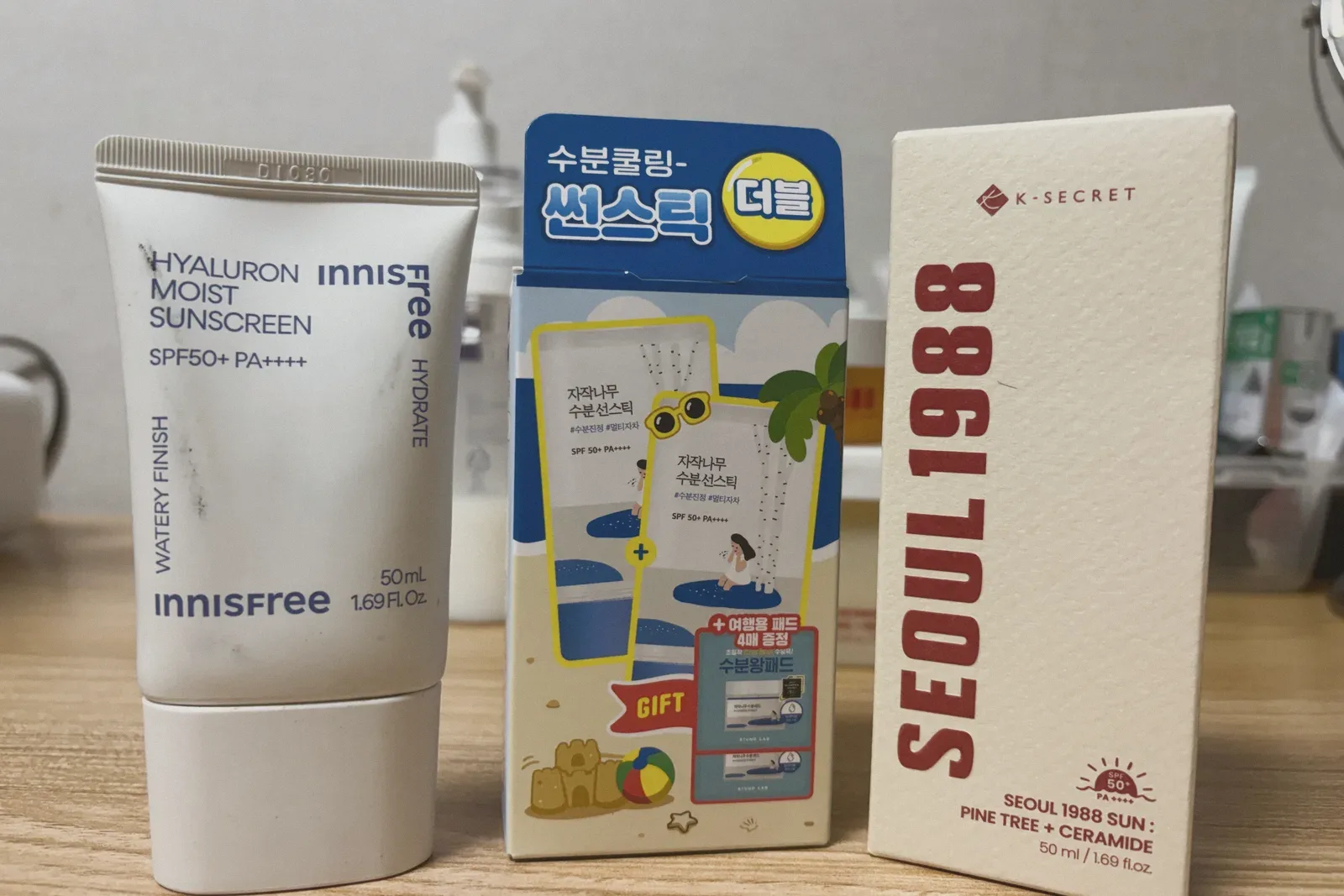
For years I disliked sunscreen itself. Most of the ones I tried made my eyes sting, and the stinging could leave me with a headache for the rest of the day. I threw out dozens. Only two never did it to me: innisfree’s Hyaluron Moist Sunscreen and ROUND LAB’s Birch Juice Moisturizing Sun Stick, and the innisfree one is what I wear every morning now. I tell that longer story in my Journal entry, The sunscreen graveyard.
This article is for general cosmetic information and is not medical advice. If your eye stays painful, red or blurry, or you have any change in your sight, get medical help.
Evidence: The evidence is thin: one lab study on cells, one company-run test of a single sunscreen, an industry-led safety review and one UK study of how people apply sunscreen around their eyes. None of them followed people through an ordinary day of wearing sunscreen.
- innisfree: Hyaluron Moist Sunscreen SPF50+ PA++++
- ROUND LAB: Birch Juice Moisturizing Sun Stick SPF 50+
Does octocrylene sting your eyes?
It has not been shown in people. In one 2026 lab study, octocrylene switched on a pain receptor in rabbit eye cells while passing two standard irritation tests, which makes it a suspect, not a proven cause.
Is mineral sunscreen better for sensitive eyes?
The studies here do not answer it. They tested organic filters and one water-based formula, and none compared mineral with chemical sunscreens for stinging. If you switch, note the filter list of each product you try.
What should I do if sunscreen gets in my eyes?
The NHS advises washing your eye with clean water, following the advice on the product's packaging, and not touching or rubbing your eye until it's better. Get urgent advice if it is very painful or not better after 24 hours.
Why do people skip sunscreen on their eyelids?
In a UK study of 84 people, participants said concern over stinging was one reason they did not cover their eyelids well. They missed 14.0% of the eyelid area with sunscreen and did not realize it.
- Zhang T, et al. Leveraging a TRPV1-overexpressing cell model: an integrated testing strategy for UV filter-induced ocular irritation. Cutan Ocul Toxicol. 2026;45(2):243-250.
- Narda M, et al. Three-tier testing approach for optimal ocular tolerance sunscreen. Cutan Ocul Toxicol. 2019;38(3):212-220.
- Norman KG, et al. Comprehensive review of octocrylene toxicology data and human exposure assessment for personal care products. Crit Rev Toxicol. 2025;55(9):890-915.
- Lourenco EAJ, et al. Application of SPF moisturisers is inferior to sunscreens in coverage of facial and eyelid regions. PLoS One. 2019;14(4):e0212548.
- NHS. Eye injuries.
Editorial content, not medical advice.