Retinal vs retinol comes down to one conversion step. Skin turns retinol into retinal, then retinal into retinoic acid, the form that changes how cells renew. Retinal skips the slow first step, so it acts more strongly at the same strength. In one small split-face trial it smoothed fine lines more, with similar comfort.
You notice it first in side light: fine lines at the corners of the eyes that stay after the smile is gone, or a patch of small bumps along the chin that foundation sits on instead of smoothing over. A vitamin A product is the usual next step, and that is where the shelf splits in two. Retinal vs retinol is the choice most people stall on, because the names differ by one letter and the labels rarely explain what that letter changes. It changes where each one starts on the same path, and that decides how fast it works and how your skin takes it.
What is the difference between retinal and retinol?
The difference is one conversion step. Skin cannot use either form directly. It has to turn them into retinoic acid, the form that switches on the genes behind cell renewal, and it does that in two moves: retinol becomes retinal (also called retinaldehyde), then retinal becomes retinoic acid.
The first move is the slow one. A 2011 study of human skin models describes the oxidation of retinol to retinaldehyde as “the rate-limiting step in the biosynthesis of retinoic acid”. Retinal starts after that bottleneck. Retinol has to queue for it.
That single step explains most of what you will read about the two. It is why retinal tends to show effects at lower percentages, why retinol has a reputation for being slow, and why neither behaves like prescription retinoic acid, which skips both steps.
Is retinal stronger than retinol?
At the same percentage, yes, in the sense that it produces a stronger retinoid response in skin. A 1994 study from the dermatology department at Geneva University Hospital measured a marker that skin cells make when retinoids reach them and ranked the forms by how strongly they raised it: retinoic acid first, then retinal, then retinol further down. In volunteers who applied 0.05%, 0.1% or 0.5% retinal for 1 to 3 months, the outer layer of skin thickened in step with the dose, a sign that renewal had sped up.
Retinol does reach the same switch, just less directly. A 1995 University of Michigan study applied up to 1.6% retinol under a covering for 4 days and found the outer skin layer thickened 1.5-fold, close to the 1.6-fold seen with 0.025% retinoic acid. Retinol caused only trace redness, while retinoic acid raised redness scores 3.7-fold. The authors described retinol as working like a precursor that the skin converts quietly.
Stronger here means more activity per drop. It does not mean harsher, which is the part people tend to get wrong.
Does retinal work better than retinol for fine lines?
In the one head-to-head trial we found, it did somewhat better. Researchers at Yonsei University in Seoul had 23 people apply a cream with retinal in tiny lipid spheres (0.05% or 0.1%) to one side of the face and a retinol cream at the same strength to the other side for 8 weeks. Both sides improved on every measure, including wrinkle depth at the crow’s feet. The retinal side improved significantly more on every measure except skin density, and neither cream caused side effects.
Keep that in proportion. It was a small study, in Korean volunteers, using an encapsulated retinal, so it does not prove every retinal serum beats every retinol one.
Retinol has its own good evidence. In a 24-week University of Michigan trial in 36 adults with an average age of 87, a 0.4% retinol lotion applied up to 3 times a week clearly reduced fine wrinkling on the treated arm compared with a plain lotion, and skin samples showed more collagen being made. A 2006 review of cosmetic retinoids summed up the balance: retinol is gentle with modest effects, while “retinaldehyde, which is fairly well tolerated, seems to be the most efficient cosmeceutical retinoid”.
So retinol works; retinal tends to work more per percent. Most of the support for both comes from small clinical trials and biopsy studies, not large long-term trials.
Is retinal more irritating than retinol?
Barely, and the difference is mostly flaking. In a 14-day patch test in 6 people, a German team found retinol and retinal had “an equally low irritation potential,” while prescription retinoic acid was clearly more irritating. Retinal did cause more scaling than retinol in that short test.
Over longer use the picture held. In a 44-week study of 355 people, retinoic acid caused redness in 44%, scaling in 35% and burning or itching in 29% during the first 4 weeks. All three were significantly less frequent with retinal. In the Geneva study’s tolerance tests in 229 patients, retinal at 0.05% and 0.1% on the face was well tolerated for up to 3 years of use, while a 1% version was tolerated by up to 70% of people.
If your skin peeled or stung on retinol, that does not rule retinal out. It usually means the dose or frequency was more than your skin was ready for.
Which should you start with, retinal or retinol?
Start with the one that matches how your skin reacts and how much patience you have.
Retinol makes sense if you have never used a retinoid, if your skin flakes easily, or if you want the form with the longest research record. Expect to wait: the retinol trial above measured results at 24 weeks.
Retinal makes sense if retinol did little for you after a few months, if you want a stronger effect at a low percentage, or if you are dealing with rough texture as well as lines. Some flaking in the first weeks is possible.
Whichever you pick, these rules apply to both:
- Go slow. Two or three nights a week for the first few weeks, then more often if your skin stays comfortable. Our guide to introducing a new skincare product covers the pacing.
- Use it at night, on clean, dry skin, followed by moisturizer. Wear sunscreen the next morning.
- Keep it off the same night as strong acids at first. Skin cycling is one simple way to separate them.
- Be careful around the eyes. A 2026 systematic review of 89 studies with 10,794 participants found that vitamin A products used on or around the eyes raised the odds of pain, dryness and burning, mostly with prescription strengths; non-prescription products were not significantly linked to more harm.
- Do not double up. Using a retinal and a retinol together only raises the total dose.
For the short definitions, see our Ingredient A–Z entries on retinal and retinol.
Editor’s note
I avoided retinoids for years. They seemed too irritating for daily use, they were for night only, they meant sunscreen the next morning, and most sunscreens made my eyes sting badly enough to give me a headache for the rest of the day. Keeping track of which nights I had used one felt like a chore on top of that.
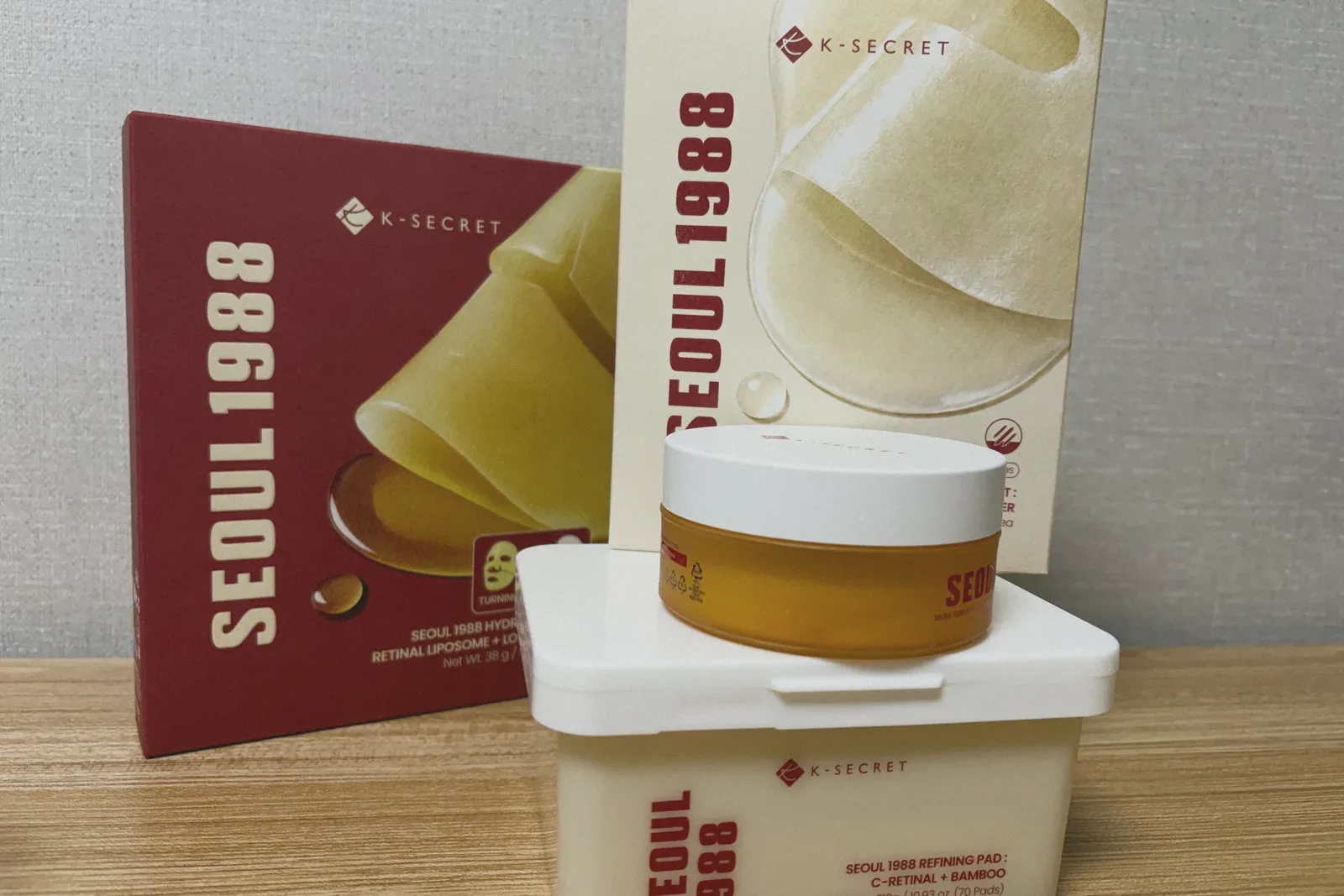
What changed it was format, not form. I started sleeping in K-SECRET’s SEOUL 1988 retinal eye patches and a retinal pad torn in half for my forehead and under my chin, because they were easy. Disclosure: editor-affiliated brand. After about two months I felt the bumps under my chin getting shallower, and the spots under my eyes seemed lighter, although those also fade every winter, so the season is part of that picture. I tell the longer version in Why I avoided retinoids for years.
This article is for general cosmetic information and is not medical advice. If you are pregnant, trying to conceive or breastfeeding, ask your doctor before using any vitamin A product.
Evidence: The comparison rests on lab and biopsy studies of how skin converts each form, irritation studies in small and large groups, and one 8-week split-face trial of 23 people; there are no large head-to-head trials.
- K-SECRET: SEOUL 1988 Retinal Glow Eye Patch: Reti-NAD + TurmericDisclosure: editor-affiliated brand.
- K-SECRET: SEOUL 1988 Refining Pad: C-Retinal + BambooDisclosure: editor-affiliated brand.
- ACROPASS: Reti-RN Microcone Patch
Is retinal stronger than retinol?
At the same percentage, yes. Retinal is one conversion step closer to retinoic acid, and in biopsy studies it produced a stronger retinoid response in skin than retinol did. Stronger here means more activity, not more harshness: irritation studies found both forms gentle compared with prescription retinoic acid.
Should beginners use retinal or retinol?
Either can work as a first retinoid. Retinol has the longer track record and caused slightly less flaking than retinal in a short irritation test. Retinal suits people who want a stronger effect at a low percentage, or who found that retinol did little for them. Start two or three nights a week with either.
Can you use retinal and retinol together?
There is no reason to layer them. They are steps on the same pathway, so stacking two products mostly raises the total retinoid dose and the chance of irritation. Pick one and adjust how often you use it.
Is retinal more irritating than retinol?
Only a little, and mostly as flaking. In a 14-day patch test, retinal and retinol had equally low irritation scores, though retinal caused more scaling. In a 44-week study of 355 people, retinal caused redness, scaling and burning far less often than prescription retinoic acid.
- Lee SA, et al. Retinol dehydrogenase 10 but not retinol/sterol dehydrogenase(s) regulates the expression of retinoic acid-responsive genes in human transgenic skin raft culture. J Biol Chem. 2011;286(15):13550-60.
- Saurat JH, et al. Topical retinaldehyde on human skin: biologic effects and tolerance. J Invest Dermatol. 1994;103(6):770-4.
- Kang S, et al. Application of retinol to human skin in vivo induces epidermal hyperplasia and cellular retinoid binding proteins characteristic of retinoic acid but without measurable retinoic acid levels or irritation. J Invest Dermatol. 1995;105(4):549-56.
- Kim J, et al. The efficacy and safety of multilamellar vesicle containing retinaldehyde: a double-blinded, randomized, split-face controlled study. J Cosmet Dermatol. 2021;20(9):2874-2879.
- Fluhr JW, et al. Tolerance profile of retinol, retinaldehyde and retinoic acid under maximized and long-term clinical conditions. Dermatology. 1999;199 Suppl 1:57-60.
- Sorg O, et al. Retinoids in cosmeceuticals. Dermatol Ther. 2006;19(5):289-96.
- Kafi R, et al. Improvement of naturally aged skin with vitamin A (retinol). Arch Dermatol. 2007;143(5):606-12.
- Abbott KS, et al. Potential harms of ocular and periorbital topical vitamin A application: a systematic review and meta-analysis. Invest Ophthalmol Vis Sci. 2026;67(11):11.
Editorial content, not medical advice.