Does oil cleansing remove closed comedones? Not on its own. A cleansing oil lifts sunscreen, makeup and surface sebum well, but a closed comedone is a plug of cells and oil sealed inside the pore. Oil-soluble salicylic acid and retinoids such as retinal have the best evidence for reaching it. Keep cleansing, but add one of those.
You melt the balm, massage for a full minute, rinse until your face squeaks, and run a finger along your jaw. The skin is clean. The tiny bumps are still there, exactly where they were last month. So does oil cleansing remove closed comedones? On its own, no. It is very good at one job, and that job happens one layer above where a closed comedone lives.
Does oil cleansing remove closed comedones?
No, not by itself. A cleansing oil dissolves what sits on the skin: sunscreen, makeup and the sebum that has spread across the surface. A closed comedone is a plug that has formed inside the pore, below the surface, and the oil you massage across your face for a minute or two is working on the surface.
The idea that it should is understandable. Comedones contain oil, and like dissolves like. But the plug is not just oil. A 2024 review in the Journal of the German Society of Dermatology traces it back to “invisible microcomedones” that form when cells inside the pore duct multiply and build up, and calls them the initial stage of comedone formation. What you can feel as a bump is cells and sebum packed together inside the follicle, weeks in the making.
Our guide to what closed comedones are covers how they differ from blackheads and milia. Here the question is narrower: what cleansing can and cannot do about them.
What does oil cleansing actually do well?
It removes stubborn, water-resistant films better than the alternatives. In a 2020 study of 20 people, researchers photographed faces before and after applying sunscreen, then had participants wash it off with water alone, a foaming cleanser or a cleansing oil. With a waterproof sunscreen, water left 59.3% of the residue behind and the foaming cleanser left 36.8%, while the cleansing oil left 5.8%, close to the bare-skin baseline. The authors concluded that “the waterproof sunscreen” may be washed off “by the cleansing oil”, and in the same study 8 people in the cleanser group reported dry skin afterward, against 1 in the oil group.
That matters for blemish-prone skin in an indirect way. If sunscreen and makeup sit in a film over your pores day after day, removing that film properly is a reasonable baseline. It just is not the same thing as clearing a plug that has already formed. Our step-by-step guide to how to oil cleanse covers the method.
Why is oil cleansing not working on closed comedones?
Because cleansing of any kind has thin evidence for changing comedones. A 2018 systematic review from NYU dermatologists searched the medical literature for studies of washing and over-the-counter cleansers in people with acne. It found 14 prospective studies with 671 participants in total, covering soaps, syndet bars, acid cleansers and washing frequency, and concluded: “Given the low number of well-performed clinical studies of cleansers and washing, it is difficult to formulate reliable recommendations.”
The review lists soaps, syndet bars, antiseptic and acid cleansers, washing frequency and several proprietary formulations; cleansing oils are not named among them. So when a cleansing oil is marketed as pore-clearing, that is a claim about the product, not a finding from controlled studies of oil cleansing and closed comedones.
There is also a contact-time problem. Anything in a rinse-off product spends a minute or two on your skin before it goes down the drain. An ingredient that needs to work inside the follicle has far more chance of doing so in a leave-on serum, pad or cream.
Can oil cleansing cause closed comedones?
It can for some people, though the answer is less simple than lists of “comedogenic oils” suggest. A 2006 study in the Journal of the American Academy of Dermatology applied finished cosmetic products under patches to the upper backs of 6 people prone to comedones, 3 times a week for 4 weeks, then counted microcomedones. Its conclusion: “Finished products using comedogenic ingredients are not necessarily comedogenic.” The formula as a whole matters more than any single ingredient on a list.
Individual ingredients can still show an effect when tested on their own. In a 2022 Korean study of 6 participants, cocoa butter applied under patches on the upper back raised the number of microcomedones per follicle compared with untreated skin within 2 weeks.
Habits count as well. In a 2021 survey of 539 acne patients at Korean dermatology clinics, 38.1% of those whose earlier treatment had not worked said continued cosmetic use made their skin worse, against 26.3% of those who had never been treated. The authors also singled out double cleansing with an oil and a water-based cleanser, and the number of cosmetics in use, when comparing the two groups. A survey shows an association at most, not that double cleansing causes comedones, but it is a reason to watch your own skin when you change your cleansing routine.
The practical reading: rinse a cleansing oil until it has fully emulsified and turned milky, always follow with a second wash, and if new bumps appear along your jaw or chin within a few weeks of switching oils, switch back.
What actually helps closed comedones?
Ingredients that work inside the follicle, used as leave-on products. Two have the clearest support.
Salicylic acid (BHA). Unlike glycolic and other alpha hydroxy acids, it dissolves in oil. A 2015 review of salicylic acid in Clinical, Cosmetic and Investigational Dermatology states that it “is a lipid-soluble agent,” and is “therefore miscible with epidermal lipids and sebaceous gland lipids in hair follicles.” In a small 1989 crossover study of 30 people with acne, a cleanser with 2% salicylic acid was compared with another acne wash over 4 weeks, and only the salicylic acid cleanser produced a significant drop in comedone counts. That is one old, small study, but it is a useful reminder that what a cleanser contains matters more than whether it is an oil.
Retinoids, including retinal. A 2005 review of topical retinoids in the Journal of Drugs in Dermatology describes them as acting on the microcomedo and on how the lining of the follicle sheds, which is the process that builds a microcomedone in the first place. For retinal (retinaldehyde), a form sold in cosmetics, the direct comedone evidence is from animals: in a 1999 mouse-model study, 0.05% retinaldehyde applied 5 days a week for 3 weeks induced comedolysis, the breaking up of comedones. Human cosmetic trials of retinal for closed comedones specifically are scarce, so treat it as a reasonable option rather than a proven one.
Neither works overnight. Give one product a consistent run of several weeks before you judge it, and add only one at a time so you can tell what is doing what.
Editor’s note
I double cleansed with oils and balms for more than ten years, twice a week, with a pharmacy AHA/BHA once a week on top, a sebum-softening product once a month and a steam towel two or three times a month. The small bumps under my lower lip did not change. What finally made them feel shallower, after about two months, was sleeping in retinal pads and eye patches. I still oil cleanse, and the one time I skipped the second wash afterward, my pores ended up more clogged, not less. I wrote about all of it in What deep cleansing couldn’t fix.
How should you cleanse if you have closed comedones?
Keep it simple and complete. If you wear sunscreen or makeup, an oil or balm first and a gentle gel or foam second is a sound evening routine; if you do not, one gentle wash is usually enough, as we explain in do I need to double cleanse if I don’t wear makeup. Use lukewarm water and a light touch on bumpy areas.
Then let the leave-on step do the comedone work. A salicylic acid serum or pad a few evenings a week, or a retinal product at night, fits after cleansing and before moisturizer. Do not start both in the same week. Patch test a new active on a small area first, and wear sunscreen the next morning if you use retinal.
When should you see a dermatologist about closed comedones?
If the bumps turn red, sore or pus-filled, spread quickly, or leave marks, or if a few months of a consistent salicylic acid or retinal routine has not changed them. Closed comedones are a non-inflammatory form of acne, and a dermatologist has options that a cosmetic routine does not.
This article is for general cosmetic information and is not medical advice. If your skin is persistently inflamed, painful or scarring, speak with a dermatologist.
Evidence: The evidence on cleansing oils comes from small studies of makeup and sunscreen removal; a systematic review found too few good trials to make firm recommendations on any cleanser for blemish-prone skin. Support for salicylic acid and retinal comes from reviews, one small cleanser trial and animal work.
- K-SECRET: SEOUL 1988 Refining Pad: C-Retinal + BambooDisclosure: editor-affiliated brand.
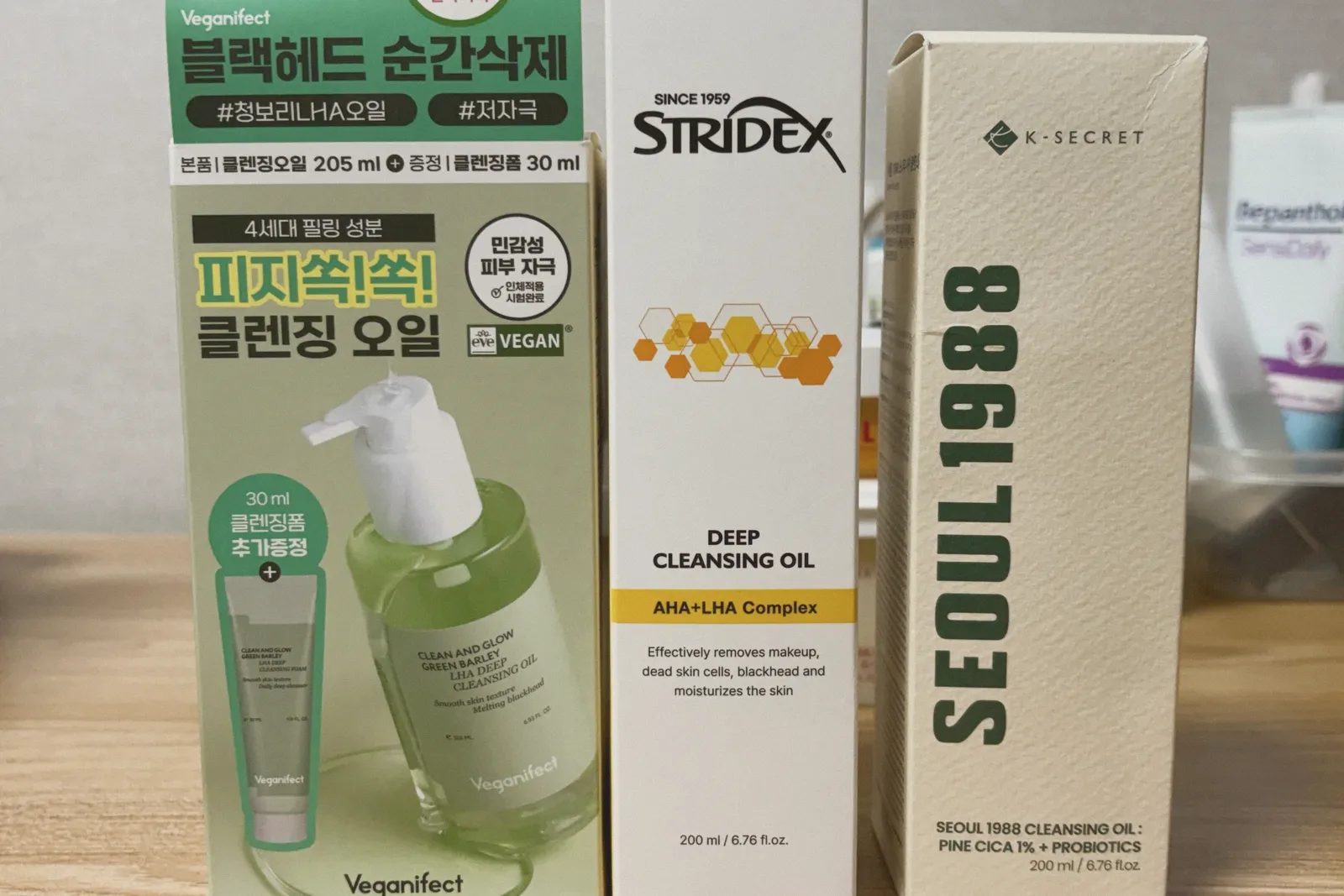
- STRIDEX: Deep Cleansing Oil: AHA+LHA Complex
- Veganifect: Clean and Glow Green Barley LHA Deep Cleansing Oil
Can oil cleansing cause closed comedones?
It can for some people, though not because oil is bad in itself. In a human patch study, finished products made with ingredients labeled comedogenic were not necessarily comedogenic. Rinse fully, always follow with a second wash, and stop if new bumps appear along your jaw within a few weeks.
Why is oil cleansing not working on my bumps?
Because it is working on the wrong layer. Cleansing oil removes what sits on the skin. A closed comedone forms inside the pore, starting as a microcomedone you cannot see, so it needs an ingredient that works inside the follicle.
What is the best treatment for closed comedones at home?
Cosmetic options with the most support are salicylic acid, which is oil-soluble and can mix with the oils inside the follicle, and retinoids such as retinal. Use one at a time, give it several weeks, and see a dermatologist if bumps turn red, sore or spread.
Should I double cleanse if I have closed comedones?
Double cleansing is fine if you wear sunscreen or makeup, and the second wash matters. A Korean survey of acne patients flagged double cleansing as one of the habits that differed between groups, so if bumps get worse after you start, cut back.
- Xie L, Hamblin MR, Zheng D, Wen X. The role of microcomedones in acne: moving from a description to treatment target? J Dtsch Dermatol Ges. 2024;22(1):9-16.
- Chen W, He M, Xie L, Li L. The optimal cleansing method for the removal of sunscreen: water, cleanser or cleansing oil? J Cosmet Dermatol. 2020;19(1):180-184.
- Stringer T, Nagler A, Orlow SJ, Oza VS. Clinical evidence for washing and cleansers in acne vulgaris: a systematic review. J Dermatolog Treat. 2018;29(7):688-693.
- Draelos ZD, DiNardo JC. A re-evaluation of the comedogenicity concept. J Am Acad Dermatol. 2006;54(3):507-12.
- Baek JH, et al. Early detection of microcomedones induced by cocoa butter using reflectance confocal microscopy. J Cosmet Dermatol. 2022;21(7):3016-3021.
- Suh DH, et al. Relationship between acne and the use of cosmetics: results of a questionnaire study in 539 Korean individuals. J Cosmet Dermatol. 2021;20(7):2172-2178.
- Arif T. Salicylic acid as a peeling agent: a comprehensive review. Clin Cosmet Investig Dermatol. 2015;8:455-61.
- Shalita AR. Comparison of a salicylic acid cleanser and a benzoyl peroxide wash in the treatment of acne vulgaris. Clin Ther. 1989;11(2):264-7.
- Bikowski JB. Mechanisms of the comedolytic and anti-inflammatory properties of topical retinoids. J Drugs Dermatol. 2005;4(1):41-7.
- Fort-Lacoste L, et al. Comedolytic effect of topical retinaldehyde in the rhino mouse model. Dermatology. 1999;199 Suppl 1:33-5.
Editorial content, not medical advice.