How to repair over exfoliated skin: stop every acid, scrub and peel, wash with a gentle cleanser, and use a plain, rich moisturizer and daily sunscreen. In barrier studies, simple emollients helped damaged skin recover, and added skin lipids did no better than petrolatum. Restart exfoliating only once nothing stings, at a lower frequency.
The moisturizer you have used for a year suddenly stings when it goes on. Your cheeks feel tight soon after you moisturize, and the pink around your nose is still there at bedtime. If you recently added an acid toner, a scrub or a stronger peel, look there first. The answer to how to repair over exfoliated skin is mostly about what you stop doing, not what you add.
How do you repair over exfoliated skin?
Stop every exfoliant at once and give your skin a short, plain routine until it is comfortable again. That means no acid toners, peel pads, scrubs, cleansing brushes or exfoliating masks, and a pause on retinoids too. The American Academy of Dermatology (AAD) notes that exfoliating while using retinoids or benzoyl peroxide can make dryness worse, and that over-exfoliating can leave skin red and irritated.
What stays is short:
- A gentle cleanser, the mildest one you own.
- A plain, rich moisturizer, applied right after cleansing, as the AAD advises after any exfoliation.
- Sunscreen every morning, ideally one your skin already tolerates. The AAD also advises against exfoliating skin that is sunburned.
- Petroleum jelly at night on the worst patches, if you want an extra layer. More on why below.
Leave out anything new and anything you would not miss. A new product on a stinging face tells you nothing, because almost everything will sting.
What are the signs of a damaged moisture barrier?
Stinging from products that used to feel neutral is the clearest sign, followed by redness that lingers, tightness soon after moisturizing, and fine flaking.
These are the same changes researchers create on purpose when they study barrier damage. In a study that damaged volunteers’ skin with repeated tape stripping, the authors reported that “Tape stripping resulted in an erythematous reaction and an increase of TEWL.” Erythema is redness, and TEWL (transepidermal water loss) is the water escaping through skin. Over-exfoliation produces the same pair of changes.
Skin in this state reacts to things it used to ignore, which is why it can feel like you have suddenly developed sensitive skin. Our guide to what sensitized skin means explains the difference between the two.
Does a ceramide cream repair the skin barrier faster than petrolatum?
Not in the studies that compared them directly. In one study, researchers damaged volunteers’ skin with tape stripping in one area and detergent in another, then treated it with either a petrolatum-rich cream containing added skin-identical lipids or pure petrolatum. They tracked recovery for 14 days by measuring water loss and blood flow in the skin. Their conclusion: “Treatment with the 2 different products gave no indication that ‘skin-identical lipids’ in a cream base are more efficient than pure petrolatum at promoting normalization in either of the 2 experimentally perturbed areas.”
A second study compared a ceramide-containing emollient, a plain control emollient and an untreated patch. The researchers damaged skin in two ways: tape stripping in 13 volunteers, and 0.2% sodium dodecyl sulphate, a harsh detergent, applied for 4 hours a day on 4 consecutive days. On day 4, the ceramide emollient had significantly lowered redness and water loss compared with untreated skin (p < 0.03), and the control emollient had done the same. Both creams helped. The authors described only some indication that the lipid formula might add a benefit after tape stripping, and the plain emollient they compared it with was petrolatum-based.
The practical reading: using a moisturizer matters much more than which barrier ingredient it advertises. If a ceramide cream is what you own and it does not sting, use it. If it stings, a simpler, richer cream or a thin coat of petroleum jelly is just as reasonable. Our look at whether ceramides repair the skin barrier goes into where ceramides do earn their place, and does slugging work for dry, tight skin explains the petroleum jelly layer night by night.
How long does it take to fix skin barrier damage?
It depends on how hard and how long you exfoliated, and the closest guide is how skin behaved in barrier studies that timed recovery day by day.
In the tape-stripping study, the treated sites already differed from untreated skin by day 4, and the petrolatum comparison followed recovery for 14 days. The dryness from a strong acid can also outlast the acid itself. In a study of 6 volunteers, 12% glycolic acid applied once a day, 5 days a week for 2 weeks, lowered skin hydration from day 11 to day 18 of the study, so the dryness outlasted the applications by several days.
So use the skin itself as the timer. When your usual moisturizer no longer stings and skin no longer feels tight after washing, the worst is over. Give it a few more calm days before you reintroduce anything active. If you still feel stinging a week after stopping, that is not a reason to add more products; it is a reason to make the routine simpler, or to suspect one of the products in it.
When can you exfoliate again after over-exfoliating?
Once your skin has felt normal for several days, and at a lower strength and frequency than before. The AAD’s guidance is that how often you exfoliate depends on your skin type and method, and that the more aggressive the exfoliation, the less often you do it. Whatever pace led to the damage, come back below it, with one product.
Strength matters as much as frequency. In the studies we covered in how to exfoliate without damaging your skin barrier, a low-strength glycolic acid used twice a day left the barrier intact, while a much higher strength used daily broke it down. Restart with one product, keep retinoids on separate nights, and stop at the first sign of stinging. Skin cycling is one way to plan those nights so acids and retinoids never overlap. If you are going back to a new product, patch test it first.
What if over exfoliated skin doesn’t get better?
Then look at the products you kept, not only the ones you stopped. Dermatologist Rajani Katta, writing for the AAD, warns that “You may develop allergic reactions to products that previously didn’t cause a problem”, so a long-trusted cream is not automatically innocent. Drop the remaining products one at a time, starting with the newest, and see which change helps.
If even a bare routine of cleanser and plain moisturizer stings, or the skin cracks, weeps or swells, stop experimenting and book a dermatologist.
Editor’s note
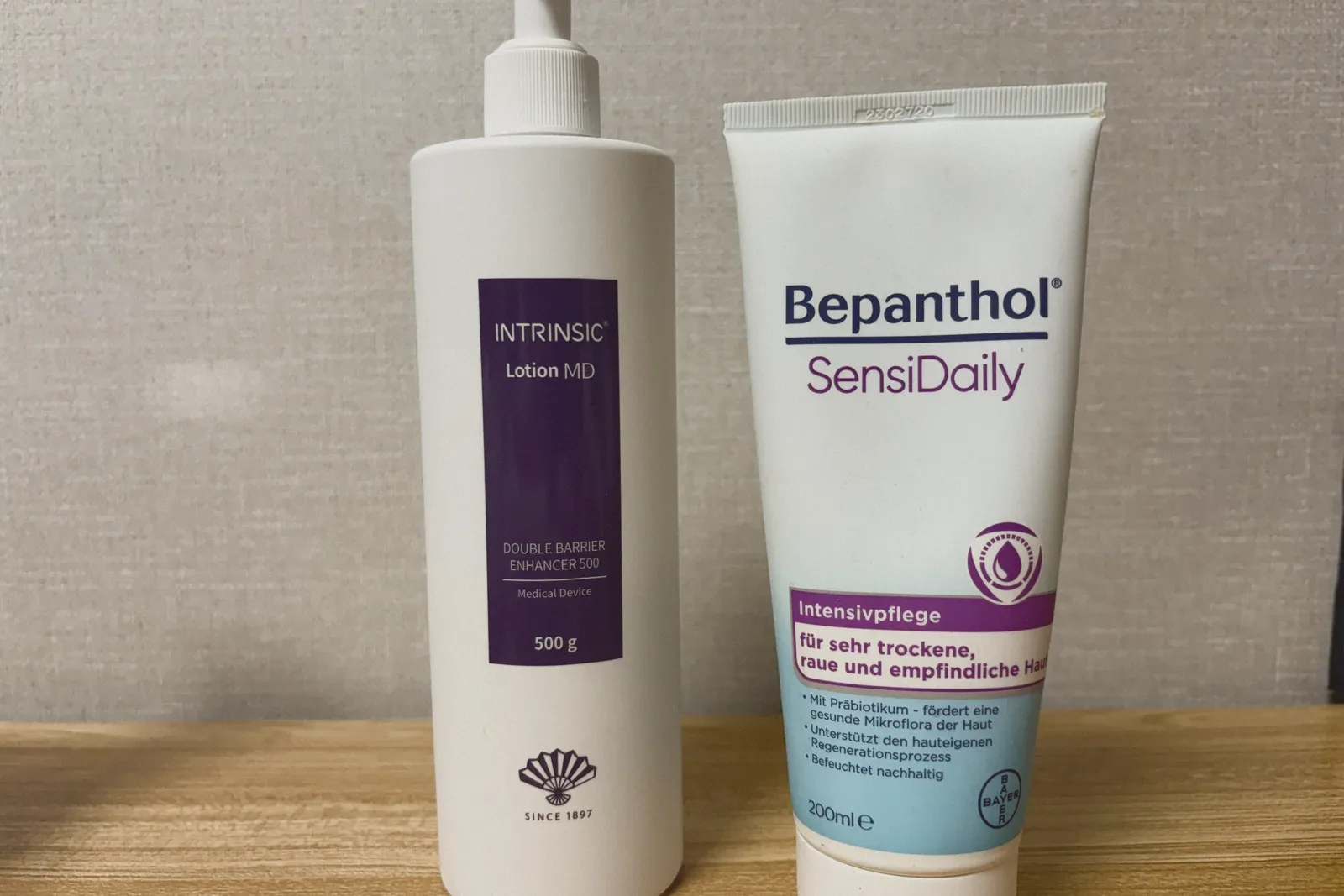
I use a pharmacy AHA/BHA product once a week, and still do. My clearest lesson in overdoing it came from brightening products, not acids: stacking several melanin-care products at once left me with dry patches and rough skin. The lotion my dermatologist gave me, Intrinsic Lotion MD, goes on comfortably even when my skin is irritated or sunburned. I also never cleanse dry, irritated skin: on dry skin, almost anything stings, so I wet my face thoroughly first.
This article is for general cosmetic information and is not medical advice. If redness, stinging or peeling lasts after you stop exfoliating, see a dermatologist.
Evidence: The recovery evidence comes from small studies that damaged volunteers' skin on purpose with tape or detergent; no trial has followed people recovering from over-exfoliating at home.
- Intrinsic: Lotion MD
- Bepanthol: SensiDaily
How do I know if I over-exfoliated?
Products that never used to sting start stinging, skin looks red but feels tight, and moisturizer seems to wear off quickly. Fine flaking and redness that has not faded by evening are common too.
Should I stop retinol if I over-exfoliated?
Pause it along with your acids until your skin is comfortable again. The American Academy of Dermatology notes that exfoliating while using a retinoid can make dryness worse, so when you restart, keep the retinoid and the exfoliant on different nights.
Is petroleum jelly good for over-exfoliated skin?
It can be. In a study of skin damaged with tape and detergent, a cream with added skin-identical lipids helped no more than pure petrolatum. A thin layer over the driest patches at night is a simple option if you do not mind the shine.
Can I wear makeup on over-exfoliated skin?
If it does not sting, yes, but keep it minimal and remove it with your gentlest cleanser. If foundation stings or clings to flaky patches, skip it for a few days and let moisturizer and sunscreen do the work.
- Lodén M, Bárány E. Skin-identical lipids versus petrolatum in the treatment of tape-stripped and detergent-perturbed human skin. Acta Derm Venereol. 2000;80(6):412-415.
- Kucharekova M, et al. Effect of a lipid-rich emollient containing ceramide 3 in experimentally induced skin barrier dysfunction. Contact Dermatitis. 2002;46(6):331-338.
- Effendy I, et al. Functional changes in human stratum corneum induced by topical glycolic acid: comparison with all-trans retinoic acid. Acta Derm Venereol. 1995;75(6):455-8.
- American Academy of Dermatology. How to safely exfoliate at home.
- American Academy of Dermatology. Skin care in your 20s.
Editorial content, not medical advice.