How to use toner pads properly comes down to pressure and strength. After cleansing, glide the pad lightly instead of scrubbing, since studies of wiping link friction to damage in the skin's outer layer, and leave the liquid on unless the label says to rinse. With acid pads, the acid's strength and pH also set how much it stings.
If your cheeks look pink and feel tight a few minutes after a toner pad, look at your hand before you blame the jar. If you pinch the pad between two fingers, press down and drag it back and forth until it feels almost dry, that grip is the place to start. How to use toner pads properly is mostly about undoing it: less pressure, fewer passes, and respect for what the liquid in the pad was built to do.
How do you use toner pads properly?
Use a toner pad after cleansing, hold it flat, glide it lightly over each area without pressing, and leave the liquid on your skin unless the label says to rinse. That is the whole technique. The rest depends on what the pad is soaked in.
The order in your routine, how often each type of pad can be used and why acid pads need sunscreen the next morning are covered in our guide to using toner pads by type, from hydrating to acid and retinoid. This piece is about the part that guide leaves to your hand: how hard you press, how many times you go over the same spot, and what the label’s small print about rinsing and contact is telling you.
Think of the pad as a way to carry liquid to your skin, not as a tool for rubbing it in. If the pad starts to drag on your skin, pressing harder only adds friction, which is the part of the habit worth losing.
Does rubbing a toner pad hard irritate your skin?
Rubbing adds friction, and studies of wiping show friction can damage the skin’s outer layer, so a hard scrub works against you. The evidence comes from tissues, not toner pads, but it points in one direction.
In a US study of 30 people, researchers wiped forearm skin repeatedly with dry tissue over 4 days and measured how much water the skin lost, a standard sign of a stressed barrier. Tissues with higher friction on a lab bench were the ones that caused more water loss in people, and microscope images of skin samples showed damage to the outer layer that matched. The authors, Koenig and colleagues, wrote: “We observed significant correlation between bench and clinical methods for measuring skin damage caused by wiping of skin with tissue.”
A Belgian study took it a step further on skin that was already stressed. Two groups of 20 people had the outer layer of forearm skin stripped with tape, then wiped it with tissues over 3 days. Wiping itself slowed recovery, but tissues loaded with a lotion of fatty alcohols and mineral oil let the skin recover significantly better than a dry tissue.
These were dry or lotioned tissues on forearms, not soaked pads on faces, so treat them as a reason for a light hand rather than a measurement of your pad. What they share with a toner pad is the motion. A pad that has gone nearly dry and is being pushed harder is the closest thing in your routine to a dry tissue dragged across skin.
How many times should you swipe a toner pad?
Swipe as few times as it takes to leave the area evenly damp, and follow the jar’s directions. More passes add more friction without the pad having anything left to give.
The forearm study above used repeated wiping on purpose, because repetition is how the damage showed up. A nursing study in Japan looked at the question from the other side: how little wiping does the job. Across 50 adults with dirt applied to their forearms, 3 wipes with a towel at light pressure (5 to 10 mmHg) removed at least 80% of it, and the researchers recommended 10 to 20 mmHg, which they described as stroking gently. Their conclusion was that “excessive wiping is not required to adequately remove dirt, regardless of the towel material used in various clinical situations.”
That study is about towels removing dirt from the body, and a toner pad’s main job is to leave liquid on the face, so it does not give you a number for your face. It does support the instinct to stop early. If one gentle pass leaves a thin, even film that you can see catching the light, a second and third pass add rubbing, not toner.
Should you rinse after using a toner pad?
No, unless the label tells you to. Whether a product stays on or is rinsed off is part of how an acid product is designed to be used safely, so the jar’s direction is the one to follow.
The US Cosmetic Ingredient Review, the industry-funded expert panel that assesses cosmetic ingredients, concluded in 1998 that glycolic and lactic acids are safe in cosmetic products at 10% or less, at a final pH of 3.5 or higher, when the product is formulated to avoid increasing sun sensitivity or its directions include daily sun protection. Salon products could go up to 30% at a pH of 3.0 or higher, but only for “brief discontinuous use followed by thorough rinsing”, applied by trained professionals. The panel’s 2013 re-review restates that split.
In other words, contact time and rinsing are built into the safety logic. A stronger product is acceptable for a short contact that ends with water. A product meant to stay on is held to a gentler strength. If a pad’s instructions say to rinse after a set time, that instruction belongs to the formula, and leaving it on overnight is using it outside its design.
Why does an acid toner pad sting?
An acid pad stings mainly because of the acid’s concentration and pH, which your technique can make worse but cannot fix. The Cosmetic Ingredient Review puts it plainly: “At a given pH, increasing the concentration increases irritation. At a given concentration, reducing the pH increases the irritation.”
The type of acid matters too. In a 1996 comparison of alpha hydroxy acids, glycolic and lactic acids were the most effective at equal strengths, and at the highest strengths tested, lactic acid stung sensitive skin less than glycolic acid did.
The FDA’s own record shows what overdoing it looks like. Between 1992 and February 2004, the agency received 114 reports of skin reactions to AHA skin care products, led by burning (45 reports) and dermatitis or rash (35), along with swelling, pigment changes and blisters. The FDA notes that the more serious reactions “appear to occur most often with products that cause the greatest degree of exfoliation, such as ‘skin peelers.’” These reports were voluntary and are now two decades old, so they show the kinds of reactions people had, not how often they happen.
Many toner pad labels list the acid but not its percentage or pH, so you usually cannot compare two jars on strength. What you can control is everything else: a light hand, no pass over broken or irritated skin, and the agency’s advice that “It is important to follow directions carefully and heed any warning statements on the label when using any cosmetic product.” If a new pad keeps stinging, rinse it off and patch test it before trying again. If your skin already feels raw from too many actives, our guide to exfoliating without damaging your skin barrier covers how to scale back.
Can you leave a toner pad on your face like a mask?
Only if the label says the pad is meant to be laid on. A hydrating pad laid on dry patches as a cool compress and an acid pad held in place on one spot are very different exposures, even though they look the same in your hand.
Leaving a pad in place means no wiping at all. It also keeps the liquid on that area for longer. For a watery, humectant-based pad, that is the point. For an acid pad, it raises the contact the formula was designed around, the same factor the safety reviews above treat as part of the dose.
Editor’s note
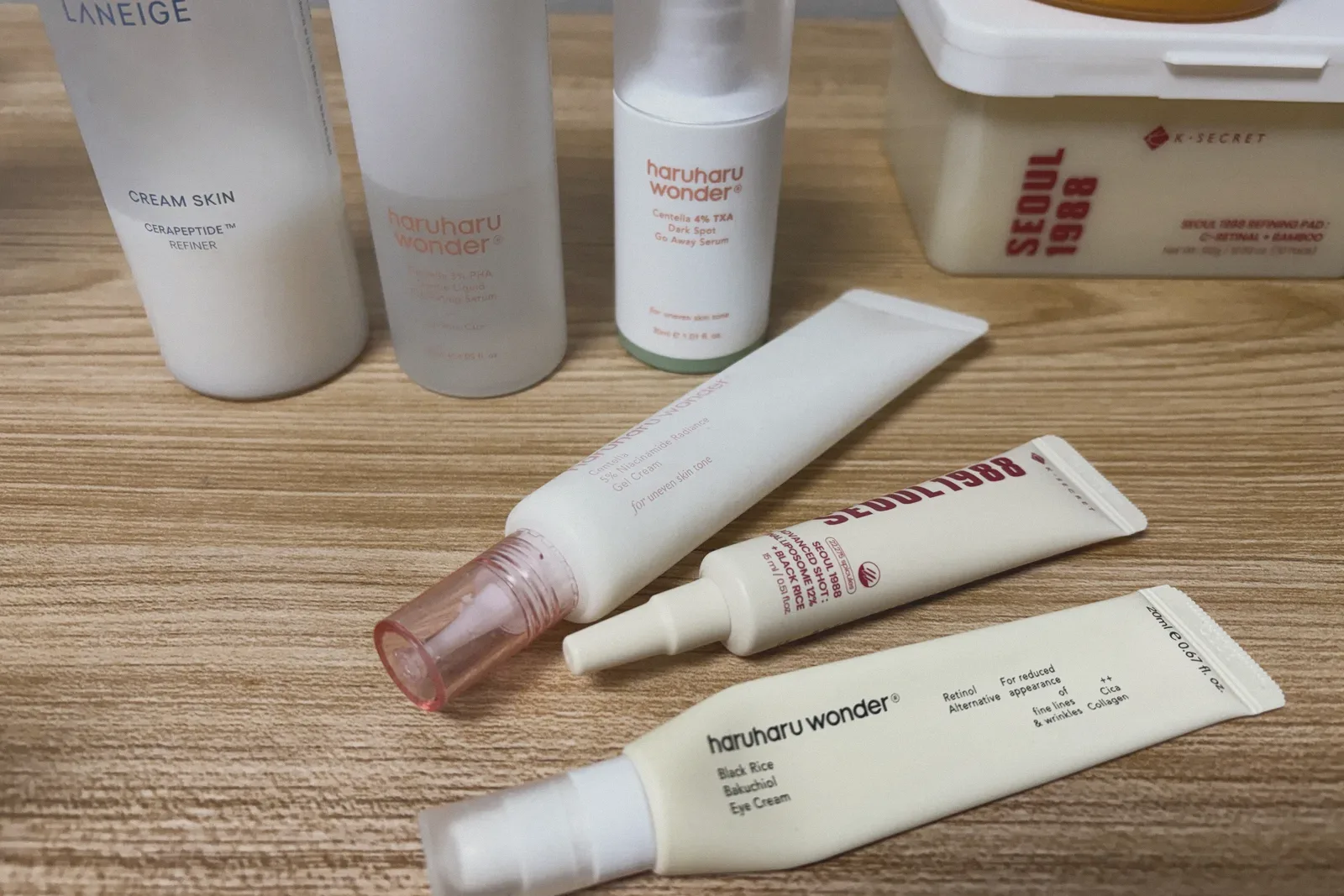
My own routine is built around touching my face as little as possible. In the evening I spray LANEIGE Cream Skin Refiner through a mist pump instead of wiping it on. My one pad step happens just before bed, and I do not swipe it at all: I tear one K-SECRET SEOUL 1988 retinal pad in half and lay the two pieces on my forehead and under my jaw, then sleep. The only time I wipe is once a month, when I put a sebum-softening product on before cleansing, let it soak in, and then wipe it away. Disclosure: editor-affiliated brand.
This article is for general cosmetic information and is not medical advice. If you have a skin condition, speak with a dermatologist.
Evidence: The friction findings come from small forearm studies of tissues and towels, not toner pads on the face, and the acid-strength guidance comes from the US Cosmetic Ingredient Review and the FDA.
- K-SECRET: SEOUL 1988 Refining Pad: C-Retinal + BambooDisclosure: editor-affiliated brand.
- numbuzin: No.5 Vitamin-Niacinamide Concentrated Pad
- HANYUL: Artemisia Soothing Toner Pads with Centella Asiatica
How many times should you swipe a toner pad?
As few as it takes to leave the area evenly damp, following the jar's directions. Studies of wiping with tissues and towels found that damage tracked friction and that extra wiping was not needed to get the job done, so more passes are not better.
Do you rinse off toner pads?
Only if the label says to. US safety limits hold leave-on acid products to a lower strength and higher pH than peels that are rinsed off, so the direction on the jar is part of how the product was meant to be used.
Why does my toner pad sting?
With an acid pad, stinging depends on the acid, its concentration and its pH. The US Cosmetic Ingredient Review states that at a given pH, a higher concentration irritates more, and at a given concentration, a lower pH irritates more. Pressing hard adds friction on top of that.
Should I use a toner pad before or after serum?
Before. Toner pads go on after cleansing and before serums and moisturizer. Acid and retinoid pads belong in the evening, with sunscreen the next morning.
- Koenig DW, Dvoracek B, Vongsa R. In vitro prediction of in vivo skin damage associated with the wiping of dry tissue against skin. Skin Res Technol. 2013;19(1):e453-8.
- De Paepe K, et al. Effects of lotioned disposable handkerchiefs on skin barrier recovery after tape stripping. Skin Res Technol. 2008;14(4):440-7.
- Konya I, et al. Minimum wiping pressure and number of wipes that can remove dirt during bed baths using disposable towels: a multi-study approach. BMC Nurs. 2023;22(1):18.
- Cosmetic Ingredient Review (Fiume MM). Safety Assessment of Alpha Hydroxy Acids as Used in Cosmetics, re-review, 2013.
- US Food and Drug Administration. Alpha Hydroxy Acids.
- Smith WP. Comparative effectiveness of alpha-hydroxy acids on skin properties. Int J Cosmet Sci. 1996;18(2):75-83.
Editorial content, not medical advice.