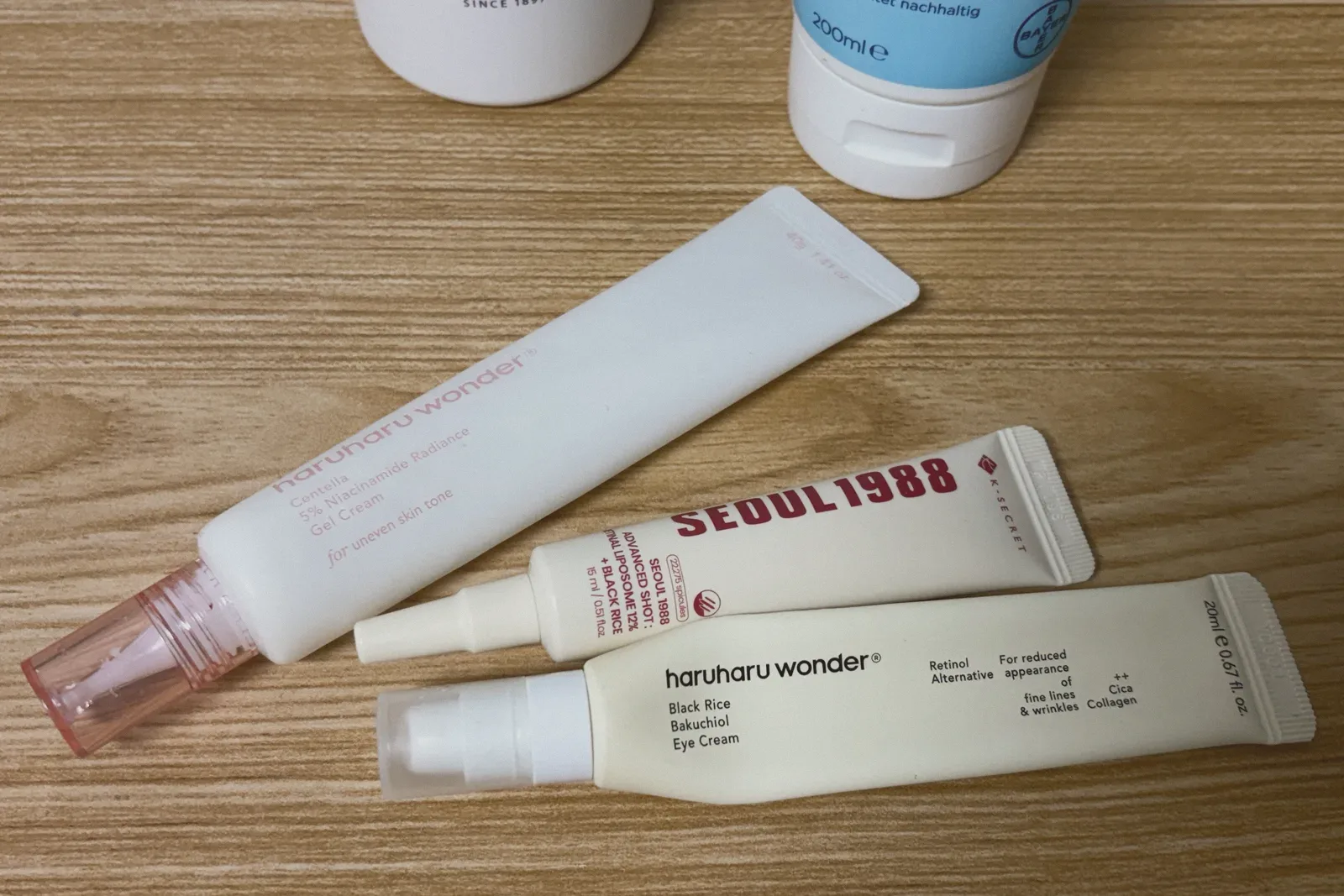
How to apply eye cream correctly: use a small amount on clean skin before your heavier face cream, and pat it along the bone under the eye with your ring finger. The American Academy of Dermatology recommends the ring finger because it is the weakest. Eyelid skin is the thinnest on the face, so a light touch matters.
If you put on eye cream with a dab on your index finger and a quick rub in small circles, you are treating it like every other cream. The skin it lands on is among the thinnest on your face, and how to apply eye cream correctly comes down to respecting that. It takes no longer than the rub: a smaller amount, a lighter finger and the right moment in your routine.
How do you apply eye cream correctly?
Use a small amount, on clean skin, early in your routine, and pat it in lightly with your ring finger. Here is the sequence:
- Cleanse, then apply any watery toner or mist. Eye cream goes on before your face moisturizer, so it touches skin rather than sitting on top of a richer cream.
- Take a small amount on your ring finger and touch it to the other ring finger, so both have a thin film rather than one blob.
- Dot it along the bone under each eye, not right up against the lash line.
- Pat, don’t rub, until the dots spread into a thin layer. Pressing lightly moves the cream without dragging the skin sideways.
- Let it settle, then go on with moisturizer, and in the morning, sunscreen.
Brands disagree on the exact amount, from a grain of rice to a pea. Start small. If the cream is still visibly shiny a few minutes later, use a little less next time.
Which finger should you use to apply eye cream?
Your ring finger. The American Academy of Dermatology (AAD) puts it directly: “When applying any cream around your eyes, use your ring finger, because it is the weakest finger and will not pull too hard on this delicate skin.”
That is practical guidance rather than a trial result, and the reasoning is simple: less pressure on skin that is among the thinnest on your face.
How thin is the skin around the eyes?
The upper eyelid has the thinnest skin on the face, at roughly a third of the thickness of the skin on the tip of the nose. A 2025 study in Poland scanned the faces of 45 living adults, aged 22 to 73, with high-frequency ultrasound at 38 points. The authors reported that “the thinnest skin was on the upper eyelid,” at a median of 573.50 μm. The thickest was at the tip of the nose, at a median of 1907 μm, more than three times as thick.
Earlier work mapped the same variation from a different angle. A US team measuring tissue rather than living skin explained their method this way: “Full-thickness punch biopsy samples were obtained at 39 predetermined anatomic locations of the face from 10 human cadaveric heads.” They reached the same answer: the least dermal and total skin thickness was in the upper medial eyelid, with the dermis there measuring 758.9 μm against 1969.2 μm at the lower nasal sidewall, the thickest site.
The AAD also describes eyelid skin as easily irritated. That is the practical reason for the light touch, and for introducing new products near the eyes one at a time.
Should you put eye cream on your eyelids?
There is no official answer, and brand advice splits both ways. Some say the upper lid is fine to pat lightly; others say to stay below the eye and under the brow only.
What is clear is the warning sign: if a product makes your eyes water or sting, keep it to the bone under the eye and away from the lashes. Before putting any new product this close to your eyes, it is worth a patch test on a less sensitive spot first.
What can eye cream actually do?
Mostly hydrate quickly, and with steady use, soften the look of fine lines over weeks. The clearest numbers come from a 2025 trial by researchers from Colgate-Palmolive and Laboratoires Filorga. As they described it, “the benefits of twice-daily applications of the eye cream for 56 days were instrumentally and clinically evaluated on 33 women.”
The timeline is worth knowing. The authors reported that “short-term results indicated skin hydration, transepidermal water loss (TEWL) and skin profilometry improvement within 15 min.” TEWL is the water escaping through skin, and profilometry measures surface texture. Wrinkles were measurably reduced by day 7 on instruments, but graders only saw a difference after 28 or 56 days.
In that trial, the quick change was hydration; the change graders could see took 28 days or more of use twice a day. This was one formula, tested by industry researchers, so treat it as a sense of the timeline rather than a promise from any eye cream. If shadows rather than lines are your concern, our skincare routine for dark circles sorts the causes and the ingredients that fit each.
Should you use eye cream morning and night?
Twice a day matches the trial above, but the right ingredient for each time differs. A plain hydrating cream sits comfortably under sunscreen in the morning. Retinoid eye creams belong at night, and they are the ones to introduce slowly: our dark circles guide covers the review linking vitamin A products near the eyes to more dryness and burning.
If you also use an overnight eye patch, the patch goes on last, after the cream has settled. For morning puffiness, a cooling patch is a different tool; we look at what is in the Laneige eye patches and which kind of tired eyes they suit.
Editor’s note
My evening routine starts with a mist pump so I barely touch my face, and right after it comes haruharu wonder’s Black Rice Bakuchiol Eye Cream. After a run of late nights at work, when the area under my eyes looks hollow and shadowed, retinal and bakuchiol are the two ingredients that feel most useful to me there. The skin around my eyes is also the part of my face most likely to complain: out of dozens of sunscreens, only two have never made my eyes sting.
This article is for general cosmetic information and is not medical advice. If the skin around your eyes itches, swells or flakes and does not settle, see a dermatologist.
Evidence: The technique advice is dermatology guidance backed by skin-thickness measurements rather than trial results, and the data on what eye cream does come from one industry-run trial of a single cream.
- haruharu wonder: Black Rice Bakuchiol Eye Cream
Which finger should you use for eye cream?
The ring finger. The American Academy of Dermatology recommends it because it is the weakest finger and is least likely to pull on the thin skin around the eye.
Do you put eye cream before or after moisturizer?
Before. Apply it on clean skin, after any watery toner or serum and before your face cream, so it touches skin instead of sitting on top of a heavier layer. In the morning, sunscreen goes on last.
Should you put eye cream on your eyelids?
Advice differs and there is no official guidance either way. If a product makes your eyes water or sting, keep it to the bone below the eye and under the brow, away from the lash line.
How long does eye cream take to work?
In one company-run trial of 33 women, an eye cream improved hydration within 15 minutes, while changes in wrinkles were measurable on instruments after 7 days and visible to graders after 28 or 56 days of twice-daily use.
- American Academy of Dermatology. Should I apply my skin care products in a certain order?
- American Academy of Dermatology. Petroleum jelly: 4 skin care uses.
- Korzekwa S, et al. Quantitative analysis of the human face skin thickness: a high-frequency ultrasound study. J Clin Med. 2025;14(23):8401.
- Chopra K, et al. A comprehensive examination of topographic thickness of skin in the human face. Aesthet Surg J. 2015;35(8):1007-1013.
- D'Arcangelis et al. In vitro, ex vivo, instrumental and clinical evaluation of a topical cream on the signs of periorbital ageing. Int J Cosmet Sci. 2025;47(1):18-30.
Editorial content, not medical advice.