How does retinal help skin texture? Skin turns retinal into retinoic acid, which speeds up renewal in the outer layer and helps loosen the plugs behind small closed bumps. In studies, comedone counts fell within 2 to 4 weeks, while clearer overall change took 2 to 3 months.
Run a fingertip along your jaw and you can feel what a mirror often misses: a scatter of tiny, skin-colored bumps that sit just under the surface. They do not hurt, they do not come to a head, and cleansers, scrubs and steam rarely move them. How does retinal help skin texture like this, when so much else does not? It works one level down, on how the outer layer renews itself and how pores clog in the first place. That is also why it takes weeks.
How does retinal help skin texture?
Retinal helps texture by changing how skin cells renew, not by sanding the surface. Skin converts retinaldehyde (retinal) into retinoic acid, the form that switches on the genes behind cell turnover, as we explain step by step in Retinal vs retinol for fine lines and bumpy texture.
The visible effects follow from that. In a Geneva study, volunteers who used retinal at 0.05%, 0.1% and 0.5% for one to three months developed a thicker outer layer of living skin, in step with the dose, along with more dividing cells: a sign that renewal had sped up. Skin that renews at a steadier pace sheds its dead cells more evenly, which tends to read as a smoother, more even surface.
There is a second effect that matters more for bumps. Many small closed bumps are closed comedones, pores plugged with dead cells and oil under a thin layer of skin (we cover how to tell in What are closed comedones?). A German review of retinoids in acne-prone skin puts the reason they help plainly: they “act against comedones and microcomedones,” the plugs that are visible and the ones too small to see yet.
Can retinal help closed comedones?
Yes, and this is where the evidence for retinal is most direct. The same German review notes that “Retinaldehyde is used in cosmetic preparations against acne,” while the stronger retinoids are prescription medicines.
In a French animal study, 0.05% retinal loosened comedones and thickened the outer skin layer as strongly as a prescription retinoid at 0.025%, over 3 weeks. Animal skin is not human skin, but it shows the mechanism is real.
The human data are smaller. In a 4-week pilot study at Yonsei University in Seoul, 23 people with closed and open comedones applied 0.05% retinal once a day and used no other skincare. They had significantly fewer closed and open comedones at both 2 and 4 weeks. Their sebum readings dropped from 327.95 to 250.65 μg/cm², and a measure of visible flaking on the skin surface fell from 10.99 to 8.89. There was no comparison group, and the study used a special nano-sized formula, so treat it as an early signal.
Larger European studies tested 0.1% retinal combined with 6% glycolic acid. In a double-blind, vehicle-controlled trial in France, the number of comedones and other blemishes was significantly lower from month 1 onwards. In another of 145 people, comedones improved from day 28, but they improved in the plain-cream group too, so that study cannot credit the retinal for the change in bumps.
One recent trial measured texture directly. In an 8-week split-face study in Sweden, 23 people used a concentrate of 0.1% retinal and 10% azelaic acid on one side of the face and a plain base on the other. On 3D imaging, “Skin texture improved by 10.9% versus baseline” and by 5.6% compared with the plain side. Azelaic acid was in the same formula, so the result belongs to the pair, not to retinal alone.
What this adds up to: retinal has a clear mechanism against clogged pores, one animal study and several small human studies behind it, and only one small trial that measured texture itself.
How long does retinal take to work on texture?
Plan on 2 to 3 months for a fair verdict. The earliest measured drop in comedones came at 2 weeks in the small Seoul study, and the controlled French studies saw comedone counts fall from about month 1.
Visible overall change took longer. In the French vehicle-controlled trial, 50.0% of people using the retinal cream had important or very important improvement at month 2, against 26.3% on the plain cream. By month 3, patients confirmed it at 86.1% against 58.8%.
That pacing fits the biology. The outer layer renews over weeks, and a plug that has already formed has to work its way out. If you stop after ten days because nothing looks different, you have stopped before any study measured a change.
Is cosmetic-strength retinal strong enough to matter?
It can be, with honest limits. A 2022 review of retinoids in skincare concluded that “there is a lack of evidence from properly designed clinical trials to support the claimed efficacy of the most commonly used retinoids as antiaging agents in cosmeceuticals.” Retinal is one of those retinoids.
That review was about lines and aging, not bumps. For clogged texture, the studies above are more encouraging, but they are small, and several mixed retinal with glycolic acid. We think the fair reading is this: retinal is a reasonable cosmetic step for bumpy, congested texture, worth a 2- to 3-month trial, and not a guarantee.
If your bumps are inflamed, painful, or spreading, a cosmetic product is the wrong tool, and a dermatologist is the right next step.
How should you use retinal for bumpy texture?
Use it at night, on clean dry skin, and build up slowly. Two or three nights a week is a sensible start. Add a night every week or two if your skin stays comfortable, and hold back if you see flaking or feel stinging the next morning.
A few practical points help it work:
- Cleanse properly first. Retinal cannot reach a pore still coated in sunscreen and sebum. If you oil cleanse, follow it with a second wash; we explain why in Does oil cleansing remove closed comedones?
- Do not stack exfoliants on the same night. Strong acids and scrubs on retinal nights raise the chance of irritation. Alternating nights works better, as in skin cycling.
- Put moisturizer on after it if your skin feels tight.
- Wear sunscreen the next morning, every morning you use it.
- Pick one retinoid. Layering retinal and retinol mostly raises the total dose and the irritation.
Formats matter more than they seem. A leave-on patch or a pre-soaked pad delivers retinal to one area and stays there, which suits texture that is limited to the chin or forehead. A serum covers the whole face. Choose the format you will actually use for 3 months, because the studies say that is how long it takes.
Editor’s note
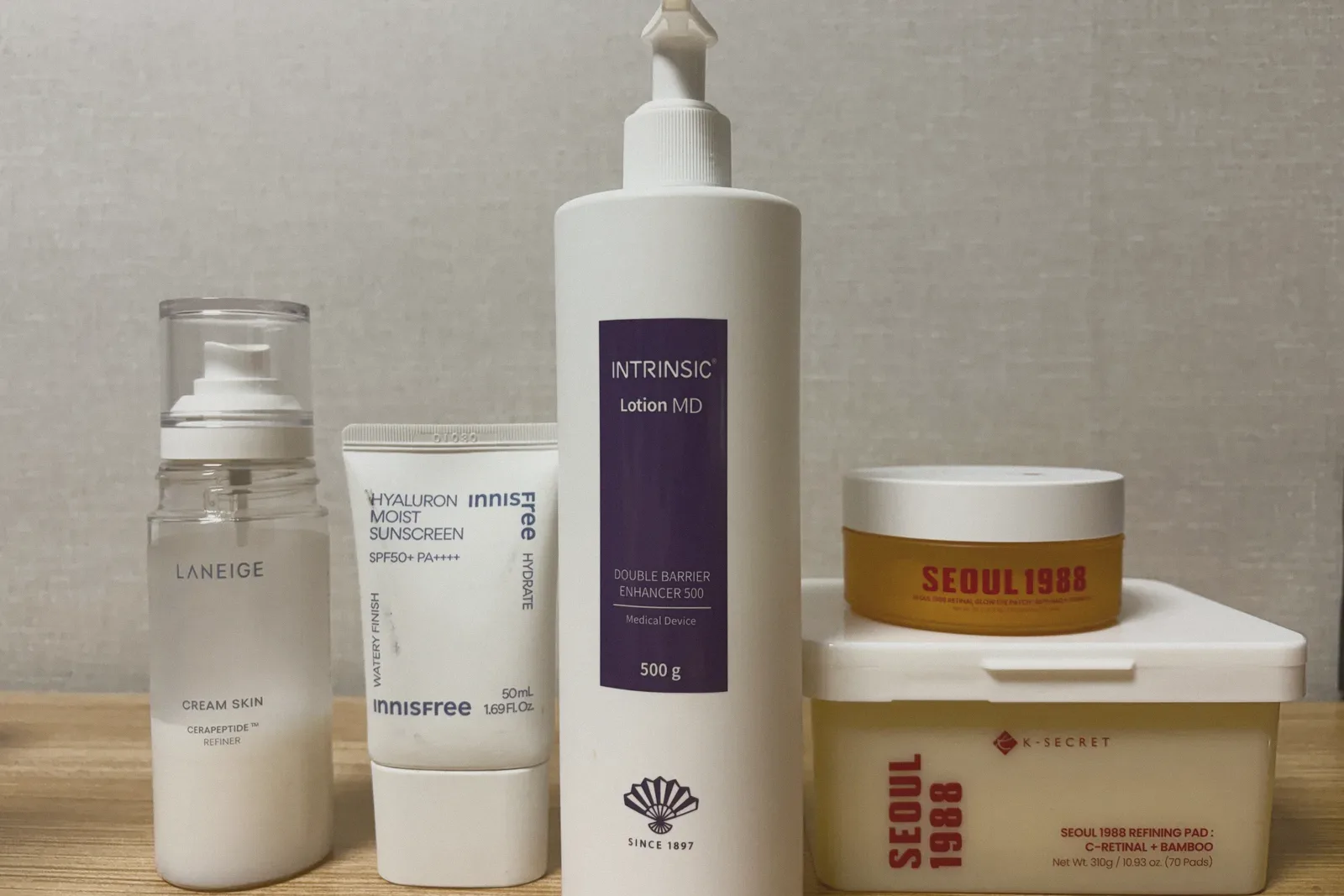
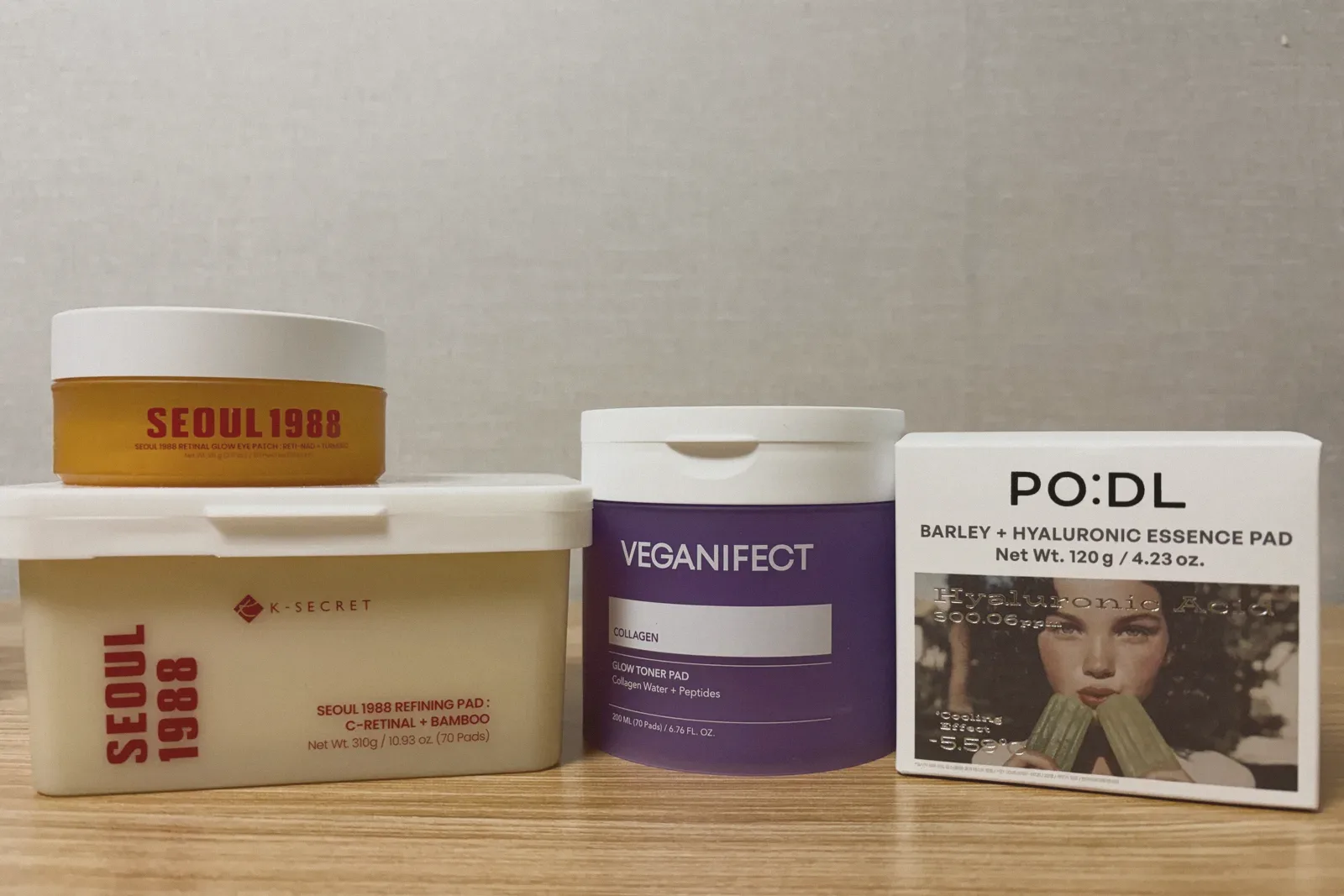
I have had a line of small bumps under my chin since high school. They hide most of the time and show when I roll my lips inward or wear foundation. For years I avoided retinal because it felt too irritating for daily use and came with a schedule I did not want to keep. What finally worked was format: I slept in K-SECRET’s SEOUL 1988 retinal eye patches and a retinal pad torn in half for my forehead and under my chin, because it was easy. Disclosure: editor-affiliated brand. After about two months, I felt the bumps getting shallower. That is one person’s experience, without measurements, and I tell the whole story in Two months of sleeping in patches.
For what retinal is in plain words, see our Ingredient A–Z entry on retinal.
Evidence: The support comes from small human studies of 0.05% to 0.1% retinal, several of them combined with glycolic or azelaic acid, an animal study and dermatology reviews; only one small trial has measured skin texture itself.
- K-SECRET: SEOUL 1988 Retinal Glow Eye Patch: Reti-NAD + TurmericDisclosure: editor-affiliated brand.
- K-SECRET: SEOUL 1988 Refining Pad: C-Retinal + BambooDisclosure: editor-affiliated brand.
- K-SECRET: SEOUL 1988 Advanced Shot: Retinal Liposome 12% + Black RiceDisclosure: editor-affiliated brand.
Is retinal good for closed comedones?
It is one of the better-supported cosmetic options. Retinoids work against the plugs that form closed comedones, and in a 4-week study of 0.05% retinal, people had significantly fewer closed and open comedones at 2 and 4 weeks. That study was small and had no comparison group.
How long does retinal take to work on texture?
Expect weeks, not days. Comedone counts dropped from about 1 month in vehicle-controlled studies, and the clearest overall improvement showed at months 2 and 3. Keep the same product for at least 8 to 12 weeks before judging it.
Can you use retinal every night?
Only if your skin stays comfortable. Start two or three nights a week and add nights slowly, holding back if stinging, flaking or tightness lasts into the next day. The studies above used retinal once a day, every evening.
Does retinal smooth skin texture better than retinol?
Retinal is one conversion step closer to retinoic acid, so at the same strength it acts more strongly in skin. A small split-face trial found retinal smoothed fine lines more than retinol, with similar comfort.
- Thielitz A, et al. Topical retinoids in acne: an evidence-based overview. J Dtsch Dermatol Ges. 2008;6(12):1023-31.
- Kim J, et al. A pilot study evaluating the efficacy and safety of retinaldehyde-loaded niosomes against mild-to-moderate acne. J Cosmet Dermatol. 2021;20(11):3586-3592.
- Poli F, et al. Efficacy and safety of 0.1% retinaldehyde/6% glycolic acid (Diacneal) for mild to moderate acne vulgaris. Dermatology. 2005;210 Suppl 1:14-21.
- Dreno B, et al. Combined 0.1% retinaldehyde/6% glycolic acid cream in prophylaxis and treatment of acne scarring. Dermatology. 2007;214(3):260-7.
- Fort-Lacoste L, et al. Comedolytic effect of topical retinaldehyde in the rhino mouse model. Dermatology. 1999;199 Suppl 1:33-5.
- Saurat JH, et al. Topical retinaldehyde on human skin: biologic effects and tolerance. J Invest Dermatol. 1994;103(6):770-4.
- Gaudicheau C, et al. Efficacy and safety of a novel anhydrous 0.1% retinal and 10% azelaic acid concentrate for blemish-prone skin: an eight-week randomized prospective split-face, vehicle-controlled study. Int J Cosmet Sci. 2026.
- Milosheska D, Roskar R. Use of retinoids in topical antiaging treatments: a focused review of clinical evidence for conventional and nanoformulations. Adv Ther. 2022;39(12):5351-5375.
Editorial content, not medical advice.