How to build a routine around retinal: use it only at night, start every other night with the gentlest product you can find, keep everything around it plain and moisturizing, and wear sunscreen every morning. Retinal is milder than prescription retinoids, but the routine exists to keep irritation low enough that you can continue for months.
Most people who give up on retinal don’t give up because it did nothing. They give up in week two, when their chin is flaking, their cheeks sting under moisturizer and they can’t remember whether last night was a retinal night. The ingredient was fine. The routine around it wasn’t built to carry it. How to build a routine around retinal is mostly a question of what you leave out, and of pacing yourself so the skin has time to adjust.
How do you build a routine around retinal?
Make retinal the one active ingredient in your evening routine, start it slowly, and surround it with plain, moisturizing steps, then wear sunscreen every morning. Everything else is detail.
It earns that central place. A review of retinoids in cosmetics from Geneva University Hospital concluded that “retinaldehyde, which is fairly well tolerated, seems to be the most efficient cosmeceutical retinoid.” Retinaldehyde is retinal’s full name. The same review described retinol and retinyl esters as non-irritating but only modestly effective. If you want to know where retinal sits in that family, our Ingredient A–Z entry on retinal covers it in plain words, and retinal vs retinol compares the two head to head.
The routine below is built around one idea: you only see results from retinal if you are still using it in month two.
How often should you use retinal when you start?
Every other night, with the gentlest product you can find. That is the American Academy of Dermatology’s (AAD) advice for retinoids in general, not a schedule tested on retinal specifically. Dr. Alster, a dermatologist quoted on the AAD’s site, puts it this way: “I advise them to use the least-intense retinoid formula they can find, and use it every other night to start.” Dr. Chapas, on the same page, is shorter: “Use the lowest formulation you can find.” The AAD also warns that moving to stronger products too quickly irritates skin.
Stepping up gradually is a studied approach, at least for retinol. In a US trial of 45 women aged 35 to 65 with sun-damaged skin, researchers moved participants through retinol serums at 0.25%, then 0.5%, then 1.0% over 12 weeks, each used with a moisturizing cream. By week 4, the retinol group’s skin was graded smoother than the comparison group’s, and their dryness improved rather than worsened. That study was about retinol, not retinal, and the abstract does not say how long each step lasted.
In practice, we would hold at every other night for two to three weeks. If your skin feels normal the morning after, add a night. If it is tight, flaky or stings when you apply moisturizer, stay where you are or drop back. Our guide to introducing a new skincare product covers this kind of pacing in more detail.
Is retinal gentle enough to use every night?
For many people, eventually, yes. Retinal has a good record on tolerance compared with prescription retinoic acid. In a German study, 355 people used retinoids for 44 weeks. In the first 4 weeks, redness, scaling and burning or itching were significantly less frequent with retinal than with retinoic acid, which caused redness in 44% of users. The authors’ summary: “The natural retinoids ROL and RAL do have a good tolerance profile, in contrast with the irritating potential of RA.” ROL is retinol, RAL is retinal and RA is retinoic acid.
Daily use has also been tested over weeks. In a French study of 55 women with sun-damaged skin, a cream with 0.1% retinal was used every day for 8 weeks and compared with a series of 3 glycolic acid peels done in a clinic. The cream refined skin texture more than the peels did, and the authors reported a 12-fold lower incidence of physical signs with the cream than with the peels. Peels are a professional procedure, so the useful part for a home routine is simply this: daily 0.1% retinal was well tolerated for two months in that group.
Well tolerated is not the same as no reaction. In a small 14-day patch test, the same German team found retinal caused more scaling than retinol. Some flaking in the first weeks is possible; burning that doesn’t settle is a sign to stop.
What order should a retinal night routine go in?
Cleanse, let your skin dry, apply retinal, then moisturizer. That is a practical order rather than a tested one: the trials we cite here used retinal or retinol alongside a moisturizer, but none of them compared one order with another.
Here is how an evening looks with retinal at the center:
- Cleanse. If you wear sunscreen or makeup, make sure it is fully off. Retinal cannot do much for a pore still coated in sunscreen and sebum, and our editorial view is that cleansing comes first in any routine.
- Wait until your face is dry. We apply retinal to dry skin; a few minutes after washing is enough.
- Apply retinal. A serum goes over the whole face. A pad or patch stays on the area you put it on, which suits texture limited to the chin or forehead.
- Moisturize. A plain, fragrance-free cream is the point here, not another active.
Moisturizer is not decoration in this routine. In a Swedish split-face trial with 23 participants, a concentrate of 0.1% retinal with 10% azelaic acid was “mixed with a moisturizer immediately before application” for 8 weeks. The researchers reported that “Adverse events were few, mild and transient,” and 65% of participants said they saw visible improvement within 4 weeks. Azelaic acid was in the same formula, so the results belong to the pair. Still, mixing retinal into moisturizer is a reasonable fallback if applying it on its own stings.
The AAD makes a related point about darker skin tones, where irritation can leave dark marks behind: “starting slowly and using moisturizer will help mitigate this possibility.”
If you use retinal near your eyes, go carefully. A 2026 US review of 89 studies with 10,794 participants found that vitamin A products used on or around the eyes increased the odds of pain, dryness and burning, mostly with prescription-strength products; non-prescription formulas were not significantly linked to more harm. Keep the product off your eyelids and away from the lash line unless it is made for the eye area.
What should you not mix with retinal?
There is no official list, so this is caution rather than rule. The AAD’s own page on retinoids does not give mixing advice. Our approach is to use one retinoid at a time and keep other strong actives, such as exfoliating acids, for different nights, at least for the first month. Layering retinal with retinol mostly raises the total amount of vitamin A on your face.
If you also exfoliate, alternating nights is the simplest structure. Skin cycling is one way to lay that out: an exfoliating night, a retinoid night, then rest nights. Once your skin has settled, you can decide whether you want to bring anything back to a retinal night.
Do you need sunscreen when using retinal?
Yes, every morning. The AAD advises using retinoids only at night and wearing sun protection during the day, “Because retinoids can make skin more sensitive to sun.” Its advice covers all skin not covered by clothing, and for sensitive skin it suggests a physical sunscreen with titanium dioxide and/or zinc oxide. That is general retinoid guidance; the AAD does not separate out retinal.
The morning side of a retinal routine can be short: a gentle cleanse or a splash of water, a moisturizer if you need one, and a sunscreen you will actually wear every day. If chemical filters bother you, our guide to the best mineral sunscreen covers the zinc oxide and titanium dioxide options.
How long before a retinal routine shows results?
Give it at least 8 weeks before you judge. The French daily-cream study and the Swedish split-face trial both ran for 8 weeks, and the Swedish participants mostly reported seeing a change within 4. If you are using retinal for bumpy texture, our piece on how retinal helps skin texture explains why 2 to 3 months is the fairer window.
The routine matters most in those first weeks, when nothing looks different yet and the temptation is to add more. Adding a second active to speed things up is how many people end up with the flaking that makes them quit.
Who should skip retinal?
Skip it if you are pregnant. The AAD is direct: “Retinoids should not be used during pregnancy.” The AAD also advises against retinoids if your skin currently has a lot of redness or inflammation. If you are trying to conceive or breastfeeding, ask your doctor before using any vitamin A product. And if your skin is flaring or broken, let it settle with a plain routine first; retinal can wait a few weeks.
Editor’s note
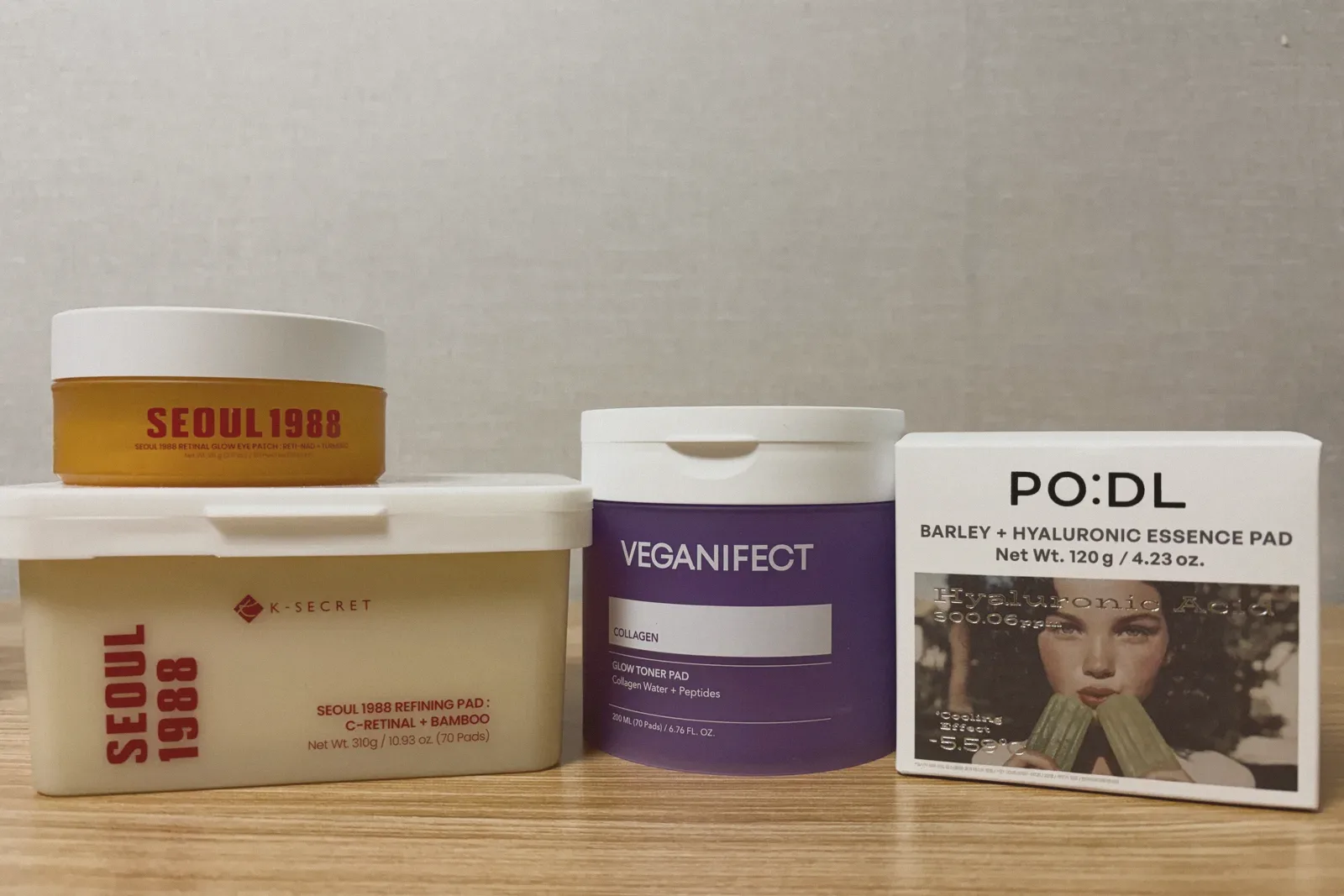
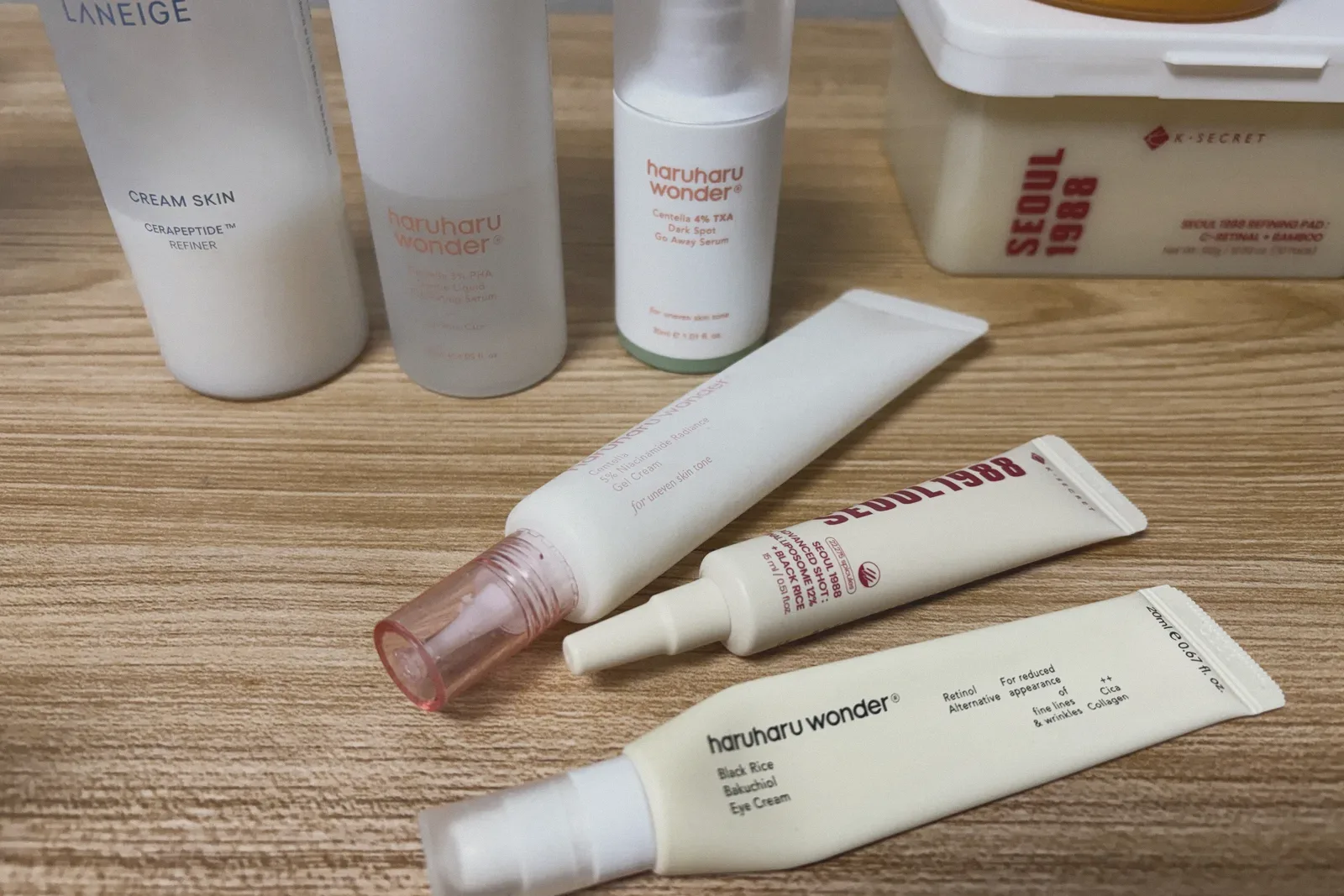
My evening routine is built so that retinal is the last thing on my face. I spray LANEIGE Cream Skin Refiner through a mist pump so I barely touch my skin, then use haruharu wonder’s Black Rice Bakuchiol Eye Cream and a tranexamic acid serum, then a lotion I got from my dermatologist, Intrinsic Lotion MD. Just before bed, a K-SECRET SEOUL 1988 retinal eye patch goes under each eye, and I tear one retinal pad in half for my forehead and under my chin. Disclosure: editor-affiliated brand. The patches stay put even when I toss and turn, and they feel less stifling than a full sheet mask. In the morning it is a gel cleanser, the mist, the same lotion and innisfree’s Hyaluron Moist Sunscreen, one of only two sunscreens I have found that don’t make my eyes sting.
For years I avoided retinal because it was night only, meant sunscreen every morning and came with a schedule I did not want to keep track of. Patches and pads made it simple enough to stick with. They also flip the serum order above: in my routine the lotion goes on first and the retinal last, and that is the order I have kept. I tell that story in Why I avoided retinoids for years.
This article is for general cosmetic information and is not medical advice. If you are pregnant, trying to conceive or breastfeeding, ask your doctor before using any vitamin A product.
Evidence: The pacing and sunscreen advice is dermatologist guidance for retinoids in general; the retinal-specific data come from a few small European trials and one long German tolerance study, and none of them tested one routine order against another.
- K-SECRET: SEOUL 1988 Refining Pad: C-Retinal + BambooDisclosure: editor-affiliated brand.
- K-SECRET: SEOUL 1988 Retinal Glow Eye Patch: Reti-NAD + TurmericDisclosure: editor-affiliated brand.
- innisfree: Hyaluron Moist Sunscreen SPF50+ PA++++
How often should you use retinal at first?
Start every other night. The American Academy of Dermatology gives that advice for retinoids in general, along with choosing the least intense formula you can find. If your skin stays comfortable for a few weeks, you can move toward nightly use.
Do you put retinal on before or after moisturizer?
Either can work. The trials we cite used retinoids alongside a moisturizer without comparing orders. We put retinal on clean, dry skin and moisturizer after it. If retinal stings, putting a thin layer of moisturizer down first, or mixing the two, is a gentler option.
Can you use retinal in the morning?
It is better kept to the evening. The American Academy of Dermatology advises using retinoids at night and wearing sunscreen during the day, because retinoids can make skin more sensitive to the sun.
What should you not mix with retinal?
There is no official list. The cautious approach is to use one retinoid at a time and keep exfoliating acids and other strong actives for nights you are not using retinal, at least until you know how your skin reacts.
Can you use retinal while pregnant?
No. The American Academy of Dermatology states that retinoids should not be used during pregnancy. If you are pregnant, trying to conceive or breastfeeding, ask your doctor before using any vitamin A product.
- American Academy of Dermatology. Retinoid or retinol?
- Fluhr JW, et al. Tolerance profile of retinol, retinaldehyde and retinoic acid under maximized and long-term clinical conditions. Dermatology. 1999;199 Suppl 1:57-60.
- Sorg O, et al. Retinoids in cosmeceuticals. Dermatol Ther. 2006;19(5):289-96.
- Gaudicheau C, et al. Efficacy and safety of a novel anhydrous 0.1% retinal and 10% azelaic acid concentrate for blemish-prone skin: eight-week randomized split-face vehicle-controlled study. Int J Cosmet Sci. 2026.
- Draelos ZD, Peterson RS. A double-blind, comparative clinical study of newly formulated retinol serums vs tretinoin cream in escalating doses. J Drugs Dermatol. 2020;19(6):625-631.
- Rouvrais C, et al. Antiaging efficacy of a retinaldehyde-based cream compared with glycolic acid peel sessions. J Cosmet Dermatol. 2018;17(6):1136-1143.
- Abbott KS, et al. Potential harms of ocular and periorbital topical vitamin A application: a systematic review and meta-analysis. Invest Ophthalmol Vis Sci. 2026;67(11):11.
Editorial content, not medical advice.